Life Cycle of Mud Daubers

Life Cycle of Mud Daubers thumbnail
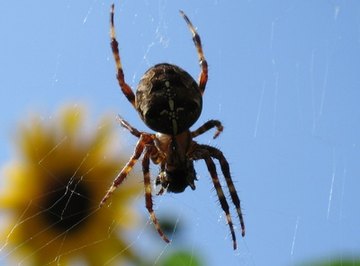
Mud daubers paralyze spiders for their larvae to feed on.

Mud daubers are a type of solitary wasp common in North America. They generally grow to be ¾ to 1 inch long and can be dull black, iridescent black, or black with yellow markings. They can be identified by their long, narrow waist. Mud daubers are generally non-aggressive insects, but their distinctive mud nests can be a nuisance.

  1. Nest Building

    • Female mud daubers build nests out of mud and clay. These nests are composed of small, round pots or long, parallel tubes, giving the wasps their other common name: organ pipe wasps. Inside each "pipe" are several cells, partitioned off with mud. Every cell includes several paralyzed spiders and a single egg. The mother does not stay to care for her young, and abandons the nest shortly after sealing it.

    Larvae

    • Mud daubers hatch shortly after the egg is laid and begin to eat the paralyzed spiders in their cells. According to Time Magazine, mud dauber larvae have a closed digestive system. They cannot excrete waste until they have finished their stored food. Once the baby mud dauber consumes all its spiders, it develops an anus, excretes a waste sac and seals off the part of the cell where the waste is stored. The larvae then overwinter in the remaining chamber.

    Pupation

    • When the mud dauber larva is fully grown--at about ¾ of an inch long--it creates a pupa. This special case protects it during the process of changing into an adult. The adult mud dauber emerges in late spring or early in summer, eating its way out of the mud cell. It releases stored waste into the cell, then flies off to feed on flowers and look for a mate.

    Parasitism

    • One mud dauber species--the blue mud dauber--does not build its own nest. Instead, it takes over the nests of other mud daubers, such as the pipe organ mud dauber and the black and yellow mud dauber. The blue mud dauber moistens the clay cell with water, pulls out the egg and the spiders procured by the nest builder, and lays it own egg inside. Then she provisions the cell with her own spiders, usually black widows, and seals the chamber again.

    Considerations

    • Mud daubers are capable of stinging, but rarely act aggressively towards humans. They can actually benefit humans by reducing the local population of dangerous spiders. Homeowners should consider leaving mud daubers and their nests alone unless they pose a specific problem.

Related Searches:

References

  • Photo Credit spider image by wilmar huisman from Fotolia.com

Comments

You May Also Like

  • Differences Between Wasps and Mud Daubers

    Differences Between Wasps & Mud Daubers. Mud daubers are a type of wasp. Both common wasps and mud daubers belong to the...

  • Fun Facts About Mud Daubers

    Entomologist Lloyd Eighme calls them "six-legged cement masons." Scientists refer to them as Hymenoptera Sphecidae, and they have several last names depending...

  • The Habits of the Mud Dauber Wasp

    Mud daubers are the friendliest of wasp species -- in more ways than one. They are capable of stinging, but rarely do,...

  • How to Kill Mud Daubers

    Mud daubers are solitary wasps that make slender tube-shaped nests from mud in high places. Like any wasp, you should avoid making...

  • Mud Dauber Removal

    Mud daubers look much scarier than they actually are. Though they are wasps, they are not aggressive and rarely attack humans. They...

  • How to Identify a Mud-Dauber

    A mud-dauber is a common term used in the western and southern United States to refer to a group of wasps in...

  • The Difference Between Regular Wasps & Mud Daubers

    Mud daubers are a type of wasp, but they are not the wasp most people think of. The term "regular wasps" refers...

  • How to Arrange a Trash the Dress Photo Shoot

    Trash the Dress photo shoots began in 2000 when photographer John Michael Cooper decided to shoot post-wedding bridal photos in unusual and...

  • The Life Cycle of Paper Wasps

    Paper wasps are black-winged wasps that grow between ¾ and 1 inch. They produce small nests that are shaped like an inverted...

  • Blue Lobster Life Cycle

    Blue lobsters possess a rare genetic mutation involving an excessive amount of protein that causes their shells to turn cobalt blue. Their...

  • Facts on Mud Brick Houses

    Mud brick is a building material that has been used throughout the world. Mud brick has many benefits, although it is not...

  • Bird Life Cycles

    Many birds migrate as a part of their life cycle, and most build a nest from sticks, mud or other material. Birds...

  • How to Remove a Mud Dauber Nest

    Mud daubers are wasps that build nests out of mud. Having wasps around the house is no fun. They're annoying, dangerous and...

  • How to Get Rid of Nesting Swallows

    Nesting swallows build mud nests that can deface and damage the eaves and walls of residential homes and commercial structures. Insect infected...

  • How to Get Rid of Mud Bees

    Mud bees, or mud daubers, are different from many types of bees and wasps in that they don't live together in colonies....

  • What Kind of Habitat Does the Black Widow Spider Live In?

    The black widow spider, or Latrodectus Hesperus, is the most venomous spider in North America. The females, which are black and shiny...

  • Types of Mud Wasps

    Types of Mud Wasps. There are numerous types of mud wasps across the world. Most are solitary wasps but a few live...

  • Life Cycle of a Horse Fly

    Horseflies are often confused with deerflies because they look almost the same and go through their larval stage in much the same...

  • What Kind of Wasps Are in Missouri?

    Paper wasps occasionally alarm Missouri residents by building nests close to their homes. Sand wasps may make people nervous by hovering around...

Related Ads

Featured