In the days before refrigeration and hygienic food handling, the sight of maggots emerging from a piece of meat was all too common. Over time, meat left exposed to air would appear to produce maggots. Francisco Redi disproved the idea of spontaneous generation centuries ago, but maggots will grow on meat if a fly has laid its eggs there.
For help identifying maggots, view the video below:
Tip: Maggots are the larvae of flies. They grow on meat because females lay eggs in a substance that provides food for the maggots after they hatch. Meat is a preferred source of maggot food for many species of flies.
Attracting Flies
In modern times, meat is processed and packed according to strict health code regulations. It is sealed in plastic and kept frozen or refrigerated until ready to prepare. However, when meat is left exposed at room temperature it may attract female flies looking for a place to lay eggs. Discarded meat scraps that are not wrapped or enclosed within a plastic bag also provide an ideal location for flies to lay eggs. Without observing the tiny eggs, the hatching maggots seem to emerge spontaneously in the meat. In the 17th century, Francisco Redi conducted experiments to show that maggots did not appear in meat kept in a sealed container, but only in meat that was left completely exposed.
Flesh-Loving Flies
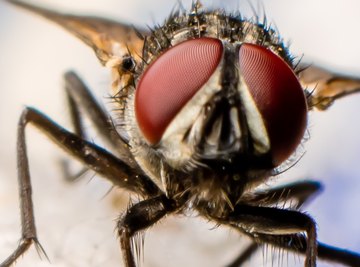
The most common types of flies that lay eggs in meat or animal carcasses are blow flies. They are also known as bottle flies for the blue or green color of their exoskeleton. Females seek out meat scraps in garbage or the body of a dead animal to lay their eggs in the decaying tissue. The flies as well as the maggots favor warm conditions for egg laying and hatching.
Fly Life Cycle
The entire life cycle of a blow fly typically spans 16-35 days. Stages of development pass more quickly in warm weather, and cool temperatures slow development. An adult female lays eggs inside meat tissue. The maggots hatch within 48 hours after the eggs are laid. The larvae pass through multiple stages of development, called instars. The larval stage continues for 3 to 9 days, depending on temperature. During the larval stage, the maggots consume meat as they burrow through the tissues. They need to eat enough to sustain them through the next stage of development.
After the maggots have changed into the final instar stage, they leave the meat source where they hatched to form a pupa. During the pupal stage, the larvae encases itself in a protective structure where it completes its development. The adult fly emerges after 10-17 days of pupation.
Maggot Mouth Parts
Unlike the sponge-like mouth parts of their parents, maggots possess anatomical structures best suited for tearing into meat. Adults inject digestive enzymes into food to liquify it and then suck up the liquid. Maggots have hook-shaped mouth parts that can separate the muscle fibers in meat. This allows them to burrow through the meat tissue and slice off pieces to ingest. The high-protein content of meat fuels the maggots’ growth and provides nutrients that are stored and utilized during pupation.
Prevention
Basic sanitary practices can reduce the likelihood of flies laying eggs in meat or meat scraps around the home. Containing meat scraps in plastic bags and keeping refuse in tightly-lidded garbage cans reduces the odors that attract flies and limits their access to the scraps.
References
About the Author
A.P. Mentzer graduated from Rutgers University with degrees in Anthropology and Biological Sciences. She worked as a researcher and analyst in the biotech industry and a science editor for an educational publishing company prior to her career as a freelance writer and editor. Alissa enjoys writing about life science and medical topics, as well as science activities for children