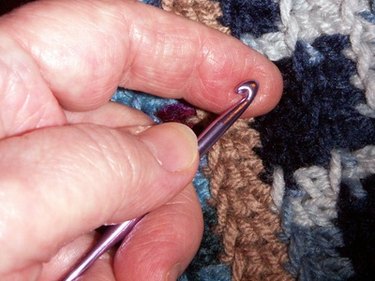
The exact origins of crocheting are unknown, and although some theories persist, there is no actual evidence of crochet before 1800. It was first popularized in Europe by Mademoiselle Riego de la Branchardiere who published simple crochet patterns for people to copy.
Between 1845 and 1850, Irish crochet became a vital source of income for women during the potato famine. Crochet hooks from this period are rare and carry the most value today. They were made from needles or pieces of stiff wire, secured into a piece of cork or wood and bent at the end to create a hook.
Video of the Day
Video of the Day
Step 1
Study the history of crocheting. Annie Louise Potter is a renowned American crochet expert and author of "A Living Mystery, the International Art and History of Crochet." Reviews agree that while her theories can be controversial, the book gives a good history of the craft. It will therefore help to identify the age of a vintage hook.
Also read Lis Palaudin's book, "Crochet: History and Technique," another useful source of antique patterns, techniques and hook styles.
Step 2
Identify the material your antique crochet hook is made from to find a date for it. Original Irish hooks are relatively simple to identify because they were the earliest and most primitive form of hook dating back to 1845-1850 and made of stiff wire and cork or wood. Crochet hooks from the Victorian period, which ran from the 1840s to 1901, were commonly made of animal bone or elephant ivory and highly decorated. Hooks became plainer in the 1920s and 1930s, but contemporary designs have returned to the more decorative style.
Step 3
Consult the Antique Pattern Library. This website includes a "vintage crochet hook size chart" and matches hook sizes and types to manufacturers. It also has comprehensive details of antique crochet patterns. These often included recommendations of hook sizes and brands and can help to identify the age of the crochet hook.
Step 4
Contact online communities of experts and enthusiasts. The website iantiqueonline.ning.com has an informative posting by Karen C.K. Ballard about antique crochet hooks, and it's free to join. She also includes photographs of examples of antique hooks to help with identification.
Step 5
Visit Ruby Lane, an online shopping outlet. The website has a page of antique crochet hooks and other items for sale and gives an idea of their value.
Step 6
Contact the Crochet Guild of America. This is a non-profit educational organization "dedicated to preserving and advancing the art of crochet" and is an essential tool when researching anything connected with crochet tools. As well as comprehensive information, the guild provides networking opportunities, exhibitions and other events related to the art.
Tip
The term "antique" is generally used for items older than 100 years, but information concerning vintage crochet hooks tends to refer up to the 1930s.
Warning
Antique crochet hooks don't have much monetary value on the open market but are nonetheless objects treasured by passionate collectors.
If you have an antique crochet hook you believe is made of ivory, get expert advice before dealing in any way with it. It's not illegal to own ivory, but there are complicated trade laws regulating the sale of it.
- I Antique Online: Figural Crochet Hooks & Information on Identifying Ivory and Bone with Overview of U.S. Trade Laws related to Worked Elephant Ivory: by Karen C.K. Ballard
- Ruby Lane: Crochet
- Needlework Through History: An Encyclopedia: by Catherine Amoroso Leslie
- The Crochet Guild of America: About
- Amazon Reviews: "A Living Mystery: The International Art and History of Crochet": by Annie Louise Potter
- Tias Mall: Danica's Antiques: Beautiful Crochet Hook - Antique
- Lis Palaudin: "Crochet: History and Technique": Interweave Press Inc