

What Is a Brad Nail?

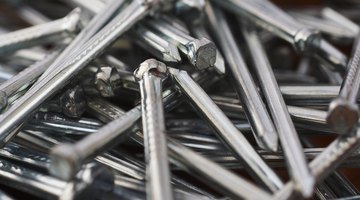
The family of nails is quite extensive, and it can be confusing when you must decide what type of nail you need for your project. Nails are used for everything from anchoring framing in construction to delicate craft projects. They come in multiple lengths and sizes -- enough to make your head spin. Before you start, you need to know the difference and which type to use. Each type of nail helps you complete a specific job, and the little brad nail has its very own place in the hierarchy of nails.
The Tiny Little Nail
A brad nail is the smallest of the nail family. It's very thin and sometimes referred to as a wire nail. Brad nails have very small heads, and can be hand-driven with a tack hammer, or shot in with a pneumatic nail gun or electric nail gun. All types are readily available at hardware stores. Brad nails come in varying lengths, from 5/8-inch to 2 1/4-inch, and closely resemble finish nails.
Brad Nails and Finish Nails
The difference between brad nails and finish nails is the gauge of the wire they're made from. Brad nails are formed from 18-gauge wire, while finish nails are formed out of 15- to 16-gauge wire. A higher wire number means thinner wire, and a smaller wire number means the wire is thicker. Finish nails have larger heads, and will also leave larger holes in trim, which must to be filled with wood putty. Obvious nail holes that haven't been filled are also known as "shiners" -- a shiner is like a black eye because you can't help noticing that it's there.
Brad Nails in Your House
Brad nails can be found in your cabinets, bookcases, fireplace, window trim, narrow baseboards and some crown molding. Anywhere you find small trim, you'll find brad nails. The small size of the brad nail prevents delicate trim and molding from splitting during installation. The head is small enough to be barely noticeable when tacked or shot into place, and it can eliminate the need to putty the nail holes.
When Not to Use Brad Nails
Brad nails should not be used to fasten large baseboards and crown molding. Heavier trim boards require a larger nail, such as a finish nail, to securely fasten them in place.
The Drip Cap
- The family of nails is quite extensive, and it can be confusing when you must decide what type of nail you need for your project.
- Nails are used for everything from anchoring framing in construction to delicate craft projects.
- The difference between brad nails and finish nails is the gauge of the wire they're made from.
- Brad nails should not be used to fasten large baseboards and crown molding**.
- Heavier trim boards require a larger nail, such as a finish nail, to securely fasten them in place.
Writer Bio
Based in Oklahoma City, Debbie Tolle has been working in the home-improvement industry since 2001 and writing since 1998. Tolle holds a Master of Science in psychology from Eastern Illinois University and is also a Cisco-certified network associate (CCNA) and a Microsoft-certified systems engineer (MCSE).
More Articles

