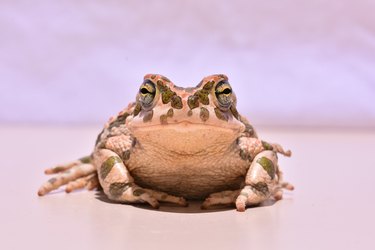
Frogs can live both in the water and on land and have unique methods of breathing to adapt to varying environments. They also have frog lungs that allow them to breathe air on land. Frogs don't have the same structures as humans and other mammals, so their lungs and respiration system work differently.
Video of the Day
Tadpole respiration methods
When tadpoles are hatched from their eggs, they do not breathe air through their lungs. Instead, they have gills that allow them to take in oxygen. Similar to fish, the gills are located on the side of the tadpole's head and are covered with a flap of skin. As the water flows over the gills, the gills filter the oxygen from the water and take it into the body while excreting carbon dioxide waste out of the body.
Video of the Day
Tadpoles develop frog lungs as they go through their life cycle to become froglets. While they are still tadpoles, they can breathe air from bubbles near the surface of the water. However, tadpoles are too small to rise above the water to breathe the air above.
How frog lungs work
Once the frogs have developed legs and lungs and can leave the water, they breathe on land using frog lungs. The lungs themselves work in a very similar way to human lungs. The tissue is expandable, and when the frog breathes in the air, the oxygen is filtered into the bloodstream. The carbon dioxide from the bloodstream is filtered back into the lungs and is exhaled.
Humans and other mammals have a diaphragm muscle that allows them to inhale and exhale. Frogs, on the other hand, do not have a diaphragm or ribs to help with respiration. Instead, they open their mouth to expand their throat sac. Then, they open their nostrils to fill the throat sac with air before closing their nostrils and throat to push the air into the lungs. This process is reversed so that the frog can exhale carbon dioxide.
Other lung functions
Frogs don't just use their lungs to breathe. They also use them to distinguish frog calls of multiple species during mating season. During this time, the sounds of frogs from a myriad of species can become deafening, making it challenging for frogs to identify potential mates.
A study published in Current Biology shows that frogs can adjust to this challenge by using their lungs. A frog will fill her lungs with air, which adjusts the frequencies to which her ears respond and helps her become more attenuated to the calls of frogs of her own species.
Frog's skin respiration process
As amphibians, frogs can live both on land and in water. While frog lungs are necessary for respiration on land, frogs have another method of respiration that allows them to breathe in the water and during hibernation as well.
Frogs have thinner skin with capillaries near the surface that allow oxygen and carbon dioxide to pass through, giving frogs another way to breathe. The slime on the frog's skin is actually mucous that keeps the skin moist. If a frog's skin dries out, he won't be able to use this method of respiration effectively.
Skin, or cutaneous, breathing is more efficient in some species than others. Some frogs, such as the Titicaca water frog, use this method of breathing almost exclusively.