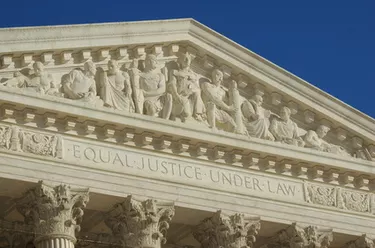
Serving as one of the U.S. Supreme Court justices is one of the highest positions in the legal world, and many law school students dream of making it there. But how much does the chief justice earn? While all Supreme Court justices are paid well, the annual salary of Supreme Court chief justices differs from associate justices, federal judges and more judicial salaries.
Chief Justice of the Supreme Court Annual Salary
Video of the Day
In 2022, the Supreme Court's leader was Chief Justice John Roberts. In 2021, he earned $280,500, according to financial disclosures. The associate justices earned $268,300; these individuals are Samuel Alito, Amy Coney Barrett, Neil Gorsuch, Ketanji Brown Jackson, Elena Kagan, Brett Kavanaugh, Sonia Sotomayor and Clarence Thomas. They also receive health benefits and other perks.
Video of the Day
Many high-ranking people in the federal government earn extra money teaching at universities in the District of Columbia area (such as Georgetown or George Washington University) or through public appearances and speaking. However, education in particular cannot add more than $30,000 annually to a judge's salary. This capped amount keeps their focus on the federal courts and avoids potential conflicts of interest.
Supreme Court judicial salaries don't necessarily reflect net worth. They often build wealth working as attorneys, district judges, appellate court judges and more. According to NBC News, John Roberts' net worth in 2016 was $4.2 million.
Other Salaries in the Judicial Branch
There are other salaries in the judicial branch that might be helpful to learn if you are hoping to make a career in this industry.
Supreme Court Clerk Salary
One of the most common positions in the Supreme Court (other than judges) is that of a clerk. Many law clerks who work for the justices are lawyers themselves. They assist the justices primarily with research regarding cases they plan to hear and others they might take up. Depending on experience, education and whether they work full time, Supreme Court law clerks usually make between $50,000 and $120,000 per year.
Federal and State Judge Salary
In the federal judiciary and state courts, many judges serve in the court of appeals, district courts, circuit courts and local and state courts. Every judge and court system also has support staff and administrative offices.
Judicial compensation for these judgeships and other positions varies widely based on several factors, including location (for example, a judge in New York earns more than in Kansas) and years of service. Still, according to the United States Bureau of Labor Statistics, judges and hearing officers earned an average salary of $128,710 in 2021. That's well above the national average.
How to Become a Supreme Court Justice
Many citizens of the United States learn at some point in their education that there are only nine Supreme Court justices in the United States. That small number means that it's challenging to rise to this position. It's critical to remember that even though justices are supposed to be impartial, judgeships are often political appointments. If you want to be a judge of any kind, you should be active in politics and aggressive about making the right connections within your political party and community.
- Get a college education. The first step to becoming a judge is to go to college. You'll need to major in a related field, such as political science, pre-law or sociology.
- Attend law school. Most high-ranking federal government judgeships go to people who attended top-tier law schools, so work hard to earn admission to one of those.
- Gain real-world experience. From there, it matters less what line of work you go into and more about how you distinguish yourself. Whether you go into academia, work for a firm or become a federal employee, you'll need to become a known expert in constitutional law.
- Write extensively and be in the public eye. You should try to publish prolifically and take on high-profile cases.
The paths taken to the highest court in the land by the current nine justices vary. Barrett worked as a law professor and a federal judge, while Jackson was a circuit judge for the court of appeals.