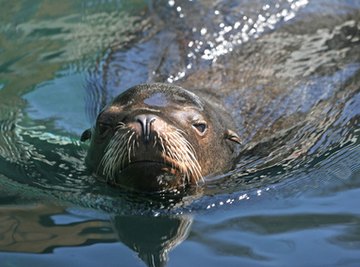

Sea lions are a type of pinniped, an order of marine mammals that also includes seals and walrus. They are superbly adapted to their oceanic habitat: streamlined and swift, well-designed for the pursuit of prey and the evasion of formidable predators.
General Morphology
Sea lions are distantly related to terrestrial carnivores like bears, but their conversion to an aquatic lifestyle has resulted in significant physical adaptations. They are equipped with large, powerful forelimbs, shaped into flippers to provide the bulk of their forward propulsion. Their hindflippers assist with steering. Extensive neck muscles provide greater range of movement in the head and neck than is found in true seals. Back and shoulder muscles are also significant, used for powering the foreflippers. The animals’ smooth form allows them to shoot easily through the water with minimal drag. Sharp teeth--not dissimilar to their terrestrial relatives--help them dispatch fish, squid and other favored prey.
Thermoregulation
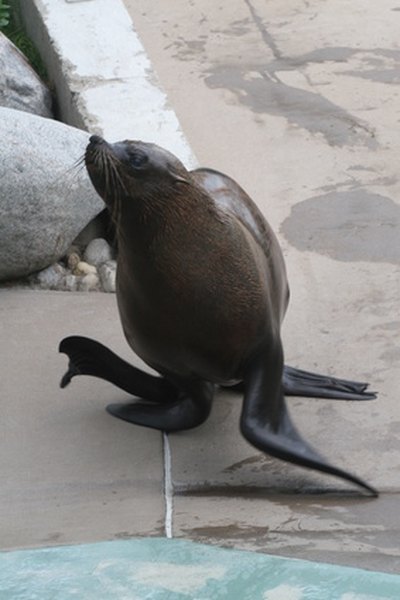
A layer of fat called blubber between the muscles and outer skin protect sea lions from frigid ocean temperatures. Most species, after all, inhabit temperate waters; the Steller sea lion will also range well north in the Pacific to the Bering Sea. Out of the water, sea lions deal with excess heat by panting and circulating blood through the flippers.
Speed
Sea lions swim fast--a useful adaptation for their predatory lifestyle. They actively hunt swift prey like herring, anchovies, salmon, hake and squid, and opportunistically take many other animals, like rockfish and lamprey. California sea lions may swim as fast as 25 miles per hour.
Maneuverability
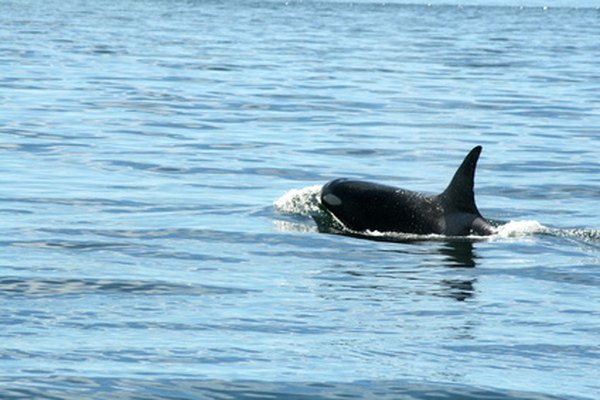
The sinuous movement of sea lions comes in handy not only when chasing prey. Big and powerful, they don’t have many predators--but those creatures that do hunt them are huge and formidably endowed. Across most of their range, sea lions’ major predators are big sharks and orcas, or killer whales. Great white sharks, for example, are devoted and efficient sea-lion hunters, stalking them from below and striking suddenly with devastating power. Orcas hunt cooperatively and possess great intelligence; they will even slide into shoreline surf to catch sea lions. But the pinnipeds’ agility often keeps them out of harm’s way.
Land Breeding
Rearing their pups on land helps sea lions reduce predation upon their young. Breeding colonies, often sited on offshore islands or rocky beaches, are typically crowded and raucous. Pups stick close to the shore, where predators are usually less numerous, until they have the speed and athleticism to give them a fighting chance.
References
- “Natural History of Oregon Coast Mammals”; Maser et al.; 1981 (p. 433; pgs. 446-454)
- “Pacific Coast”; Bayard H. McConnaughey, Evelyn McConnaughey; 1986 (pgs. 406-407)
Resources
About the Author
Ethan Shaw is an independent naturalist and freelance outdoors/nature writer based in Oregon. He holds a B.S. in Wildlife Ecology and a graduate certificate in G.I.S. from the University of Wisconsin-Madison. His primary interests from both a fieldwork and writing perspective include landscape ecology, geomorphology, the classification of ecosystems, biogeography, wildlife/habitat relationships, and historical ecology. He’s written for a variety of outlets, including Earth Touch News, RootsRated, Backpacker, Terrain.org, and Atlas Obscura, and is presently working on a field guide.
Photo Credits
Sea lion image by Stana from Fotolia.com