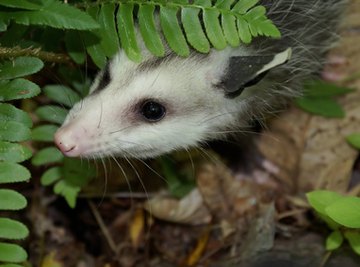
Opossums are found throughout North and South America while their cousins come from Australia. Opossums are marsupial mammals. While 'opossum' is their forml name, in general usage they are often referred to as possums. Opossums are marsupials.
Marsupials are unique in that they do not have a placenta, so their young complete most of their development in a pouch. There are more than 100 species of opossum living in the Americas, including water opossums (Chironectes minimus) and the only marsupial in the United States and Canada, the Virginia opossum (Didelphis virginiana).
What Are Adaptations?
Adaptations are the evolutionary responses organisms have that make them better suited to their environment. When a change offers an organism an advantage which makes them become fitter by producing more offspring, it will spread throughout a population. Adaptations help organisms source food more effectively, improve offspring survival and avoid or defend from predators. Adaptations are genetic and may or may not be physically evident.
Opossum Adaptations
Opossums have evolved a keen sense of smell to help them seek out foods such as insects, fruit, plants and small animals in the night. They have a prehensile tail and appendages called hallux on their hands and feet which act like thumbs to help them climb trees and navigate their arboreal environment. Opossums also use scent glands and vocalization to communicate with each other.
The Amphibious Opossum of South America
Also called a yapok, water opossums are found from Mexico all the way down to Argentina. Their webbed feet help them navigate rivers, streams and lakes. Special water opossum adaptations include female's being able to close their pouch to keep young dry. The lutrine creature type adaptations of water opossums help them to catch freshwater crabs, fish, frogs and shrimp that live in the waterways.
Opossum Defense Mechanisms
As small mammals opossums are potentially vulnerable to predatory mammals in the Americas including birds of prey, coyote, wild cats, raccoons, bobcats and snakes. When an opossum feels threatened, it will make loud growling and hissing noises, defecate, urinate and run away. If an opossum also has young to protect, she may bite.
While these responses are relatively common responses to threatening situations in the animal world, opossums have another unique adaptation for dealing with predators called 'playing dead.' When opossums play dead, they don't simply lie on the ground, close their eyes or stare blankly into space and stay still. Opossums take playing dead a step further and bare their teeth while foam exudes from their mouths and a bad-smell fills the air. They can stay in this state for up to four hours.
Neutralizing Snake Venom
The predator avoidance adaptations of opossums don't stop there. Scientists have found a peptide in the blood of Virginia opossums that can neutralize snake venom. This peptide gives opossums some protection from the venom of snakes such as the western diamondback rattlesnake (Crotalus atrox). Researchers are working to see if the natural venom neutralization of opossums could be used as a universal anti-venom for humans and other animals. Additionally, opossums have been found to have a resistance to toxins such as botulism, honeybee and scorpion stings.
Resistance to Rabies
Unless a human or animal is vaccinated, contracting the rabies virus is typically a death sentence. It is transmitted through bites and replicates quickly. There is currently no treatment once it has established itself in the host body. Every mammal is vulnerable to contracting rabies; however, there are very low rates of rabies seen in opossums. The low rate of rabies in opossums is thought to be due to their relatively low body temperature preventing the virus from establishing.
References
About the Author
Adrianne Elizabeth is a freelance writer and editor. She has a Bachelor of Science in Ecology and Biodiversity, and Marine Biology from Victoria University of Wellington in New Zealand. Driven by her love and fascination with all animals behavior and care, she also gained a Certificate in Captive Wild Animal Management from UNITEC in Auckland, New Zealand, with work experience at Wellington Zoo. Before becoming a freelance writer, Adrianne worked for many years as a Marine Aquaculture Research Technician with Plant & Food Research in New Zealand. Now Adrianne's freelance writing career focuses on helping people achieve happier, healthier lives by using scientifically proven health and wellness techniques. Adrianne is also focused on helping people better understand ecosystem functions, their importance, and how we can each help to look after them.
Photo Credits
peeking opossum-rb image by Tijara Images from Fotolia.com