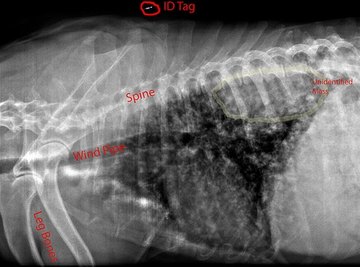

The lungs are the organs that are responsible for gas exchange. Oxygen enters the body through the trachea and down to the lungs, where blood is pumped in from the heart. The lungs are also responsible for removing carbon dioxide from the blood. The process exchanges oxygen for the waste product carbon dioxide. This is why it's given the term "gas exchange." The lungs are a major organ of the respiratory system, and they are a secondary organ for the cardiovascular system.
Basic Anatomy
There are two lungs, and each surrounds the heart in the chest cavity. The right lung is made of three lobes: the upper, middle and lower sections. The left lung is slightly smaller than the right lung because it is embedded in the chest cavity with the heart. The left lung only has two lobes, upper and lower.
Inhaling
When a person inhales, the chest expands and the diaphragm pushes against the lungs. This causes the lungs to expand and air enters into the cavity. Air enters the lungs through the trachea, which is connected to the mouth. Air travels through the trachea into alveoli, which are balloon-like structures responsible for gas exchange. The alveoli are surrounded by blood vessels that deliver blood for the exchange of oxygen.
Exhaling
Exhaling is the body's way of removing the carbon dioxide after gas exchange. When the body exhales, the diaphragm relaxes and the lungs are able to return to the previous position. The air is pushed out by the lungs and sent back through the trachea and out of the mouth. This process happens autonomously and without effort.
Gas Exchange
Gas exchange is processed in the alveoli. The alveoli are round structures that fill with air when a person inhales.These tiny, balloon-like structures are surrounded by capillaries. The blood is pumped by the heart and through the pulmonary vein. This deoxygenated blood is then sent to the capillaries, where the very thin membrane allows red blood cells to pick up the available oxygen in the alveoli. Once the blood has the oxygen, it returns to the heart, where it is pushed back to the body via the arteries.
Protection
The lungs and heart are in the rib cage to protect them from damage. The lungs also have internal mechanisms to rid the airways of germs. Tiny hair-like structures called cilia move back and forth and push germs and mucous out of the airways. Additionally, the lungs are protected by the white blood cells, which destroy viruses and bacteria as they enter the body. Types of white blood cells that circulate in the lungs are macrophages and natural killer cells.
References
About the Author
Lysis is the pen name for a former computer programmer and network administrator who now studies biochemistry and biology while ghostwriting for clients. She currently studies health, medicine and autoimmune disorders. Lysis is currently pursuing a Ph.D. in genetic engineering.
Photo Credits
Image by Flickr.com, courtesy of Ewen Roberts