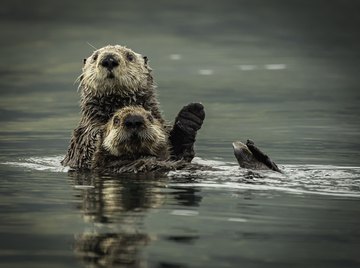
Sea otters are endangered, carnivorous sea mammals that live off the coasts in the northern Pacific ocean, from California to Alaska, the eastern coast of Russia and up to northern Japan. While they are prey to a number of large predators and tend to swim in frigid water, they have many different methods of defending themselves.
Threats
The sea otter has several natural predators from which it needs to protect itself. Great white sharks and orcas will eat sea otters, especially if larger prey like seals and sea lions are not available. Bald eagles, bears and coyotes will also eat sea otters. Sea otters must also be able to defend themselves from the cold waters in which they swim.
Escape
The sea otter's primary mode of avoiding danger is escape. According to the Fish and Wildlife Service, they can swim at speeds of up to 5.5 miles per hour, which allows them to get away from pursuing predators. They can also hide in the kelp forests, where they usually make their homes. Depending on the predator, they may also escape by going up on land.
Fur
The sea otter has thick, dense fur--the most dense of any animal. Its fur has long waterproof guard hairs that keep the short, dense underfur dry. In this way, cold water is kept away from the skin and there is little body heat loss. Every day, the sea otter needs to spend hours grooming its fur and fluffing it out. If the fur becomes too dirty, it will grow wet too quickly, preventing it from trapping air.
High Metabolism
The sea otter's high metabolism also defends it from the cold. Its body temperature is normally around 100 degrees Fahrenheit and, to maintain it, a sea otter needs to consume and process about 25 percent of its body weight in food each day.
Considerations
Oil spills can prove dangerous for sea otters. Oil can cover a sea otter's fur, destroying its insulating properties, causing the otter to die of cold. Otters are unable to clean all of the oil from their bodies and would need humans to manually wash the oil from their fur.
References