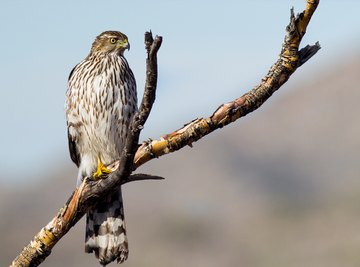
Among the most important predators of terrestrial ecosystems across much of the planet, hawks are a rather loose category of raptors (birds of prey) encompassing two major groups within the family Accipitridae: the accipiters and the buteos, typically labeled “hawks” in the New World and “buzzards” in the Old World. Hawks range in mass from Africa’s little sparrowhawk, which weighs a mere few ounces, to buteos such as North America’s ferruginous hawk and Asia’s upland buzzard, which at better than 4 pounds outsizes more than a few eagle species. Given that wide size spectrum and an equally varied ecological purview – not to mention wickedly hooked beaks, razor-sharp talons and famously keen eyes – it’s not altogether surprising hawks eat such a dizzying variety of prey.
Insects and Other Invertebrates
All sorts of hawks hunt invertebrates, whether occasionally or heavily. Swainson’s hawks, for example – slender, midsized buteos that summer in western North America and winter in Argentina – feed heavily on insects outside the breeding season: from crickets and grasshoppers to dragonflies and moths. It's not only terrestrial invertebrates at risk, either: Red-shouldered hawks will snatch crayfish out of the water, and both swamp harriers and Fiji goshawks have been known to hunt prawns.
Lizards, Snakes and Other Reptiles
Lizards, snakes and other reptiles fall on the menus of many hawks. Nearly a third of the diet of red-shouldered hawks in some areas may consist of such cold-blooded fare, including a variety of turtles. Snake-hunting can be risky for these raptors: Two very widespread North American species, the red-tailed hawk and the Cooper’s hawk, have both been known to succumb to the bites of venomous snakes, such as cottonmouths and rattlesnakes, that they apparently targeted as prey, though such mortality is probably more common among young and/or inexperienced birds.
Small Mammals
Small mammals – rodents, shrews, lagomorphs (rabbits, hares and pikas) and others – compose the nutritional backbone for many hawks around the world. Cottontail rabbits can make up close to half the prey share of red-tailed hawks in North America. On both their high-Arctic breeding grounds and their Lower-48 wintering grounds, rough-legged hawks heavily hunt small mammals: from lemmings and ground squirrels to shrews, voles and pocket gophers. The hefty ferruginous hawk of western North America mainly targets mammals, too: prairie dogs, ground squirrels, jackrabbits and others. The northern goshawk ranks among the major predators of snowshoe hares in North America’s boreal forest.
Other Birds
Hawks certainly serve as some of the most noteworthy predators of their feathered cousins. Many accipiters are essentially avian specialists. The tiny hawk of Central and South America targets hummingbirds, for example. Sharp-shinned hawks and Cooper’s hawks of North America and sparrowhawks of the Old World represent just about a songbird’s worst nightmare, able to pursue such nimble quarry with great agility through dense brush or forest canopies. Goshawks and large buteos have the heft to take down bigger birds such as waterfowl, grouse, pheasants, quail and the like.
Raptor Depredation: Hawks Eating Animals We Value
Hawks the world over often suffer a bad reputation as a threat to domestic poultry as well as the gamebirds people like to hunt as well. The positive benefits of these fine-tuned raptors to humankind vastly outweigh the occasional depredations, though, especially when you consider how many rodents – potentially destructive to crops and vectors of disease – they remove on a daily basis. Will a redtail or other large hawk attack a dog or cat? Occasionally, but that danger is significantly overrated, and it’s certainly unlikely if you’re closely accompanying your pet.
References
- Cornell Lab of Ornithology: All About Birds – Swainson's Hawk: Life History
- Notornis: Short Note – Harriers Fishing
- Florida Field Naturalist: Red-Shouldered Hawk (Buteo Lineatus) Predation of Turtles in Central Florida
- Journal of Wildlife Diseases: Apparent Fatal Snakebite in Three Hawks
- Cornell Lab of Ornithology: All About Birds – Rough-legged Hawk: Life History
- Hummingbirds of North America; Dan True
Resources
About the Author
Ethan Shaw is an independent naturalist and freelance outdoors/nature writer based in Oregon. He holds a B.S. in Wildlife Ecology and a graduate certificate in G.I.S. from the University of Wisconsin-Madison. His primary interests from both a fieldwork and writing perspective include landscape ecology, geomorphology, the classification of ecosystems, biogeography, wildlife/habitat relationships, and historical ecology. He’s written for a variety of outlets, including Earth Touch News, RootsRated, Backpacker, Terrain.org, and Atlas Obscura, and is presently working on a field guide.