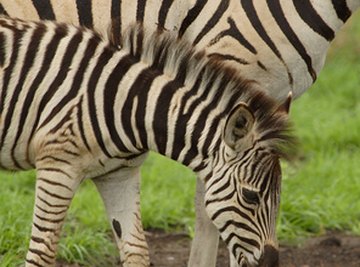
The zebra is one of the most plentiful grazing animals in Africa, with three different species (plains or Burchell's zebras, Grevy's zebras and mountain zebras) and a number of distinct subspecies that live in areas ranging from open grasslands to mountain slopes and plateaus. All three species sport distinctive white-and-black striped coats of fur, although when first born the babies have brown and white stripes that quickly darken toward black.
The Birth of a Baby Zebra
A baby zebra's life begins when, after about 13 months of gestation or pregnancy, the mother separates from her herd or family group to hide from predators while she gives birth. The young zebra, called a foal, usually weighs around 70 pounds at birth. Most zebra babies can stand within 10 to 20 minutes of birth, and within an hour they can walk and even run. The mother usually keeps her baby separate from other zebras for a few days, driving away any curious interlopers, until she and baby have had time to bond. Baby zebras use sight, sound and smell to help identify their mothers once they rejoin the herd or family group.
Tips
Early life is hard for a zebra. Infant mortality is around 50 percent, mostly due to predation. The average lifespan for most zebras is around 20 to 25 years in the wild, or up to 40 years in captivity.
When Are Baby Zebras Born?
All species of zebra breed throughout the year, but births tend to peak during the rainy months. For plains zebras that means October to March. In the Grevy's zebra range, births typically peak in May and June or November and December, and for mountain zebras, births tend to peak in the period from December to February or November to April, depending on the subspecies.
What Do Baby Zebras Eat?
Baby zebras may suckle from mom for up to a year and a half, but the most intense period of nursing usually lasts less than nine months. Young zebras usually start nibbling grass within just a few weeks of birth. Depending on where they live, zebra food also includes bark, fruit, stems, twigs, roots and leaves. If it happens to live in a zoo, a zebra will usually be fed a combination of nutritious pellets and hay.
Baby's New Family
A baby zebra's new family unit depends on where it lives. Plains and mountain zebras live in small groups called harems, with one dominant stallion, a cluster of mares, and their recent young. The mares mate with the stallion of their group, unless he's driven off and replaced by another.
Grevy's zebras live in family units with a very loose social structure based primarily on mothers and their young; the only stable relationships here are those of a breeding stallion to his territory and of the mother to her recent young. Regardless of the zebra species, social relationships are reinforced by mutual grooming.
Typically, young female zebras become independent on their mothers at around a year and a half of age, while young male zebras may remain for as long as three years. Once on their own young males typically form bachelor herds, a sort of reservoir that can produce new breeding stallions if one is needed.
The Great Migration
Although individual zebra herds, harems or family units often number less than a dozen animals, they often feed in company with other African animals including wildebeest, antelope and ostriches, with the various species depending on each other to help spot predators. Smaller groups of zebras can also come together in loose, temporary aggregate herds that number in the hundreds.
Except for mountain zebras, which have generally good access to year-round water and forage, most zebras must follow the rains for access to water and grass. During these great migrations they sometimes gather into herds that number as many as 10,000 individuals and travel up to 1,800 miles, one of the last remaining wildlife spectacles in the world. Baby zebras learn these great migration routes during the time they spend with their mother.
Why Do Zebras Have Stripes?
All zebras have stripes over most of their body, with vertical stripes on the foreparts merging into horizontal stripes on the hindquarters. No two zebras have exactly the same stripe pattern, but there are some differences between species: For example, Grevy's zebras and mountain zebras have white underbellies; on plains zebras, the belly is striped. Mountain zebras also have an unusual dewlap hanging from its throat.
Challenges a Baby Zebra Will Face
Artifacts show that zebras were once widespread throughout Eurasia, but they're now common only in southern and southwestern Africa and parts of East Africa. All three zebra species face steep habitat loss due to human encroachment and livestock grazing. The most common wild predators include lions and hyenas, but zebras may also be hunted by wild dogs, cheetahs and leopards. Humans also hunt them for both their meat and their distinctive furs, and crocodiles are a threat at river crossings.
References
About the Author
Lisa studied mathematics at the University of Alaska, Anchorage, and spent several years tutoring high school and university students through scary -- but fun! -- math subjects like algebra and calculus.
Photo Credits
young zebra image by Victor Soares from Fotolia.com