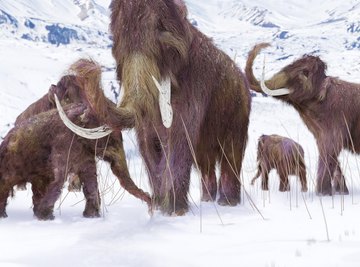
Facts About the Wooly Mammoth

Facts About the Wooly Mammoth thumbnail
Woolly mammoth bones are found across Siberia and North America

The woolly mammoth (Mammuthus primigenius) died out about 10,000 years ago, although a population of dwarf mammoths survived until 1700 B.C. on the Arctic Wrangel Island. They first appear in the fossil record some four million years ago in Africa. Woolly mammoths were one of the mammoth family, now all extinct, and were closely related to the extinct mastodon and the surviving African and Asian elephants. Woolly mammoths were found across North America and Eurasia in tundra and grassland habitats.

  1. Description

    • Woolly mammoths were up to 12 high feet at the shoulder and weighed as much as 12 tons. They were covered in dense fur up to a metre long with a fine undercoat of wool. Mammoths had small ears, curved tusks up to 16 feet long and a high, domed head. They are believed to have lived in family herds and to migrate between food sources throughout the year.

    History

    • Woolly mammoths appear in prehistoric cave paintings in France, Spain and Britain and also feature in tribal legends in North America and Siberia. They were present in North America when the continent was first inhabited by man. In 1796 French scientist Georges Cuvier was the first western scientist to study mammoth bones and recognize them as the remains of an extinct species closely related to the elephants. Mammoth ivory is still collected in Siberia as a substitute for elephant ivory.

    Habitat

    • During the ice ages, large areas of northern Eurasia and North America were covered in ice sheets. Woolly mammoths lived on the flat tundra and grasslands south of the ice sheets. These areas are believed to have been covered in grass and mosses as well as shrubs. Mammoths are believed to have had to consume up to 700 pounds of vegetation a day to survive.

    Extinction

    • Recent evidence suggests that woolly mammoths survived in Europe and Siberia until 8000 B.C., with a small population surviving until 3750 B.C. on St. Paul's Island in Alaska and a dwarf race alive on Wrangel Island until 1700 B.C. Their extinction is believed to have been caused by a combination of the disappearance of its habitat at the end of the last ice age and human hunting.

    Frozen Mammoths

    • Several complete woolly mammoth carcasses have been discovered preserved in the permafrost of Siberia. The most famous example was Dima, a 40,000-year-old baby mammoth discovered in 1977 in northeastern Siberia. In 2007 a female calf, nicknamed Lyuba, was discovered in Russia. There has been much speculation about the possibility of cloning the mammoth but since freezing damages cells and DNA, this remains impossible with current technology.

Related Searches:

References

  • Photo Credit mammoth bone image by Vladislav Gajic from Fotolia.com

Comments

You May Also Like

  • Woolly Mammoth Fossil Facts

    The woolly mammoth was a prehistoric animal that co-existed for a brief time with early humans. Their fossils are often very well...

  • Information on the Woolly Mammoth & Saber Tooth Tiger

    The saber toothed tiger, a ferocious predator, and the woolly mammoth are two mammals that have become extinct. Science knows much about...

  • About Wooly Mammoths

    The wooly mammoth, also called the tundra mammoth, is an extinct elephant-like creature that roamed the earth during the Pleistocene epoch from...

  • What Is the Difference Between a Mastodon & a Woolly Mammoth?

    Woolly mammoths and mastodons share much in common. They're both prehistoric mammals resembling modern-day elephants, with trunks, tusks and massive bodies. However...

  • Prehistoric Mammal Activities for Kids

    Prehistoric mammals lived 65 million years ago. The last Ice Age included woolly mammoths, saber-toothed cats and giant sloths. Prehistoric mammals lived...

  • How to Clean Mammoth Crocs

    Mammoth Crocs™ are fuzzier versions of the popular Crocs beach shoe, which established itself as must-have footwear because of its odor-resistant, easy...

  • How to Raise Woolly Bear Caterpillars

    Your child has come in from the garden with his newly found pet -- a woolly bear caterpillar -- and you can't...

  • The Differences Between Mammoths & Elephants

    Elephants and mammoths both belong to the Elephantidae family and share many similarities. However, both of these massive mammals had differing characteristics...

  • The History of Mammoth Mountain

    Mammoth Mountain is located in Central California, just east of Yosemite National Park. It is part of the Sierra Nevada Mountain Range,...

  • About High End Chess Sets

    High end chess sets marry form and function. Based upon the classic chess pieces and board, the high end chess sets take...

  • About the Habitat of the Manatee

    The habitat of a manatee plays a key factor as to how the manatee survives, how it's physical characteristics play a part...

  • Hemlock Woolly Adelgid Life Cycle

    The Hemlock woolly adelgid is an insect native to East Asia that targets the sap of hemlock trees. Its presence in North...

  • Saber Tooth Tiger Amazing Facts

    The saber tooth tiger lived around 1½ million years ago in South and North America and became extinct during the last Ice...

  • How to Control Woolly Croton

    Wooly croton is an invasive annual weed native to the warmer climates of North America. The plant grows from one to three...

  • Animal Information on Tigers

    Tigers are members of the Felidae family. There are six subspecies of tigers: Amur (or Siberian), Bengal, Indochinese, Malayan, South China and...

  • How to Determine the Value of Ivory Carvings

    Ivory carvings, fashioned for thousands of years from the tusks of mammoths, elephants, rhinos and other animals, still captivate collectors even after...

  • Dinosaur Fossil Facts

    Before they became extinct 65 million years ago, dinosaurs dominated the planet for over 160 million years. Studying dinosaur fossils helps us...

Related Ads

Featured