What is the Chemical Structure of Diamonds?
Diamonds are frequently seen, worn as jewelry, but few people understand what diamonds are composed of or where they come from. Diamonds are mined, whether above or below ground, in 25 countries around the world and on every continent, with the exception of Europe and Antarctica. The most commonly known countries are South Africa, Russia, Australia and Canada. Because of their chemical structure, diamonds have unique properties that set them apart from other gems and minerals. Does this Spark an idea?
-
How Diamonds Form
-
Diamonds are formed in the mantle of the Earth, the layer between the crust and the core. It is at this depth that the extreme heat and pressure necessary to form diamonds exist. In general, the shallowest depth at which diamonds form is 93 miles, or 150 kilometers, below the Earth's surface.
Where Diamonds are Found
-
There are two sources of diamonds, known as primary and secondary sources. Primary sources of diamonds are Kimberlite and Lamproite pipes that are created as a result of volcanic explosions deep in the Earth's mantle. Kimberlite and Lamproite ores are formed as the magma from the mantle hardens after an eruption. This rock is diamondiferous, or diamond bearing. The pipes formed are carrot shaped and connect the Earth's mantle with the surface. These pipes are tapped into by diamond miners to collect and process the ore for diamonds.
The secondary source of diamonds is surface deposits. There are three types of surface deposits. Eluvial deposits are scatterings of diamonds found at the entrance of a diamond pipe. Colluvial deposits are found adjacent to a diamond pipe. The most common surface deposit is the allluvial deposit.
Alluvial deposits are most often found in or near water sources. Alluvial diamond deposits are the result of wind and water erosion of diamond pipes, which transports the stones away from the source. Many of these deposits are at the sites of fossilized channels of ancient rivers and fossil beaches.
-
Chemical Structure
-
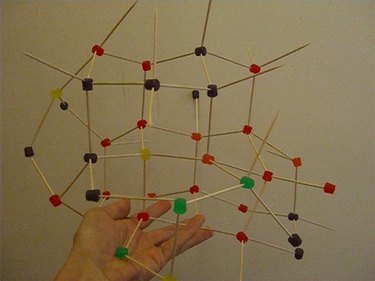
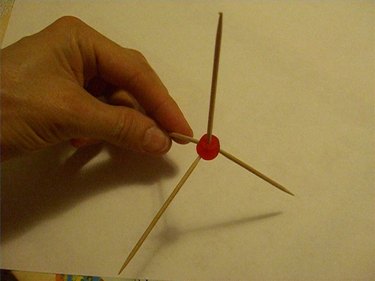
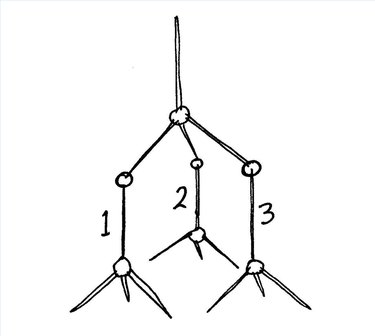
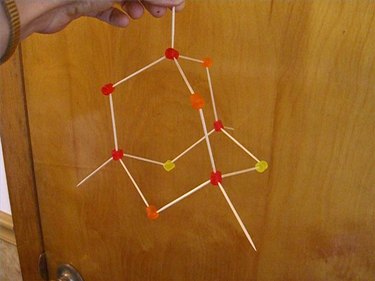
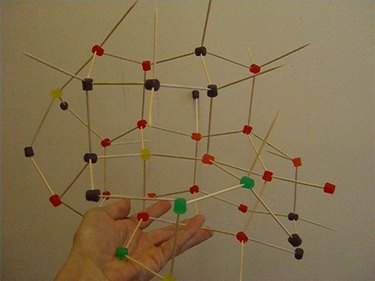
Diamond structural unit Diamonds are composed of pure carbon, the same carbon that is found in every living thing. The type of bond the carbon atoms form makes a diamond unique. Carbon atoms have six protons and six electrons. Four of the electrons are valence electrons, which are able to form bonds with other atoms. In a diamond, all four valence electrons of each carbon atom bond with the valence electrons of the adjacent carbon atoms. This bond, called a covalent bond, is the strongest bond possible. These bonds form structural units. Diamond's structural unit is a cube consisting of eight carbon atoms.
Properties of Diamonds
-
Diamonds have three significant properties due to their chemical structure. Diamond is the hardest mineral on the planet. Hardness is measured on the Mohs scale, developed by Friedrich Mohs in 1812, of mineral hardness. This is a relative scale of hardness from one to 10, as compared to other minerals. Diamond is the hardest mineral at 10 and talc is the softest at one. All other minerals are assigned hardness grades relative to these two minerals. Diamond's hardness has given rise to the myth that they are scratch proof. They are not. Diamonds can scratch each other.
The refractive index is also very high, at 2.417. Refraction is the bending of light as it moves through transparent surfaces. A diamond's is very high and, as light bounces off its facets, pulls light into its center. This refraction creates the signature shine of a diamond.
The dispersion rate of diamonds is .044. Dispersion is the separation of light into its component colors. Diamond's high dispersion rate creates a greater breakdown of light, resulting in the signature sparkle, or scintillation as it's known in the industry.
Types of Diamonds
-
While composed of pure carbon in their essential structure, diamonds often absorb nearby minerals in their formation, resulting in the presence of small minerals and other imperfections, known as inclusions, in the stone. Diamonds with the fewest inclusions are sold as gemstones, while diamonds with the highest numbers of inclusions are sold as industrial diamonds, or boart.
-
References
- Photo Credit clearcut diamond image by sumos from Fotolia.com atom_grid image by Sergey Tokarev from Fotolia.com