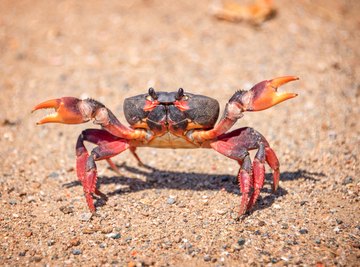
Along with arachnids, crustaceans and insects belong to the same group—arthropods. Sharing distinctive physical characteristics, such as absence of backbone, hard exoskeletons, jointed legs and segmented bodies, arthropods are easily distinguished from other animal groups. Although the arachnids are easily differentiated from other arthropods, the distinctions between crustaceans and insects are present, but a bit trickier to spot at times.
Body Parts
Differing mostly in their body parts, insects, such as ants, flies, wasps and dragonflies, have tri-segmented bodies consisting of the head, thorax and abdomen; crustaceans, such as crabs, lobsters, shrimps and crayfish, have only two body segments — the head and thorax. These two segments fuse together into a cephalothorax and an abdomen. Insects have three pairs of legs attached to their thoracic region. Crustaceans have more than three pairs of legs — usually five pairs in most species; however, this is highly variable as many species have more pairs.
Habitat and Related Adaptation
Insects are found in almost all ecosystems on Earth, with the rarity being oceans. While some species, such as coconut crabs, sand hoppers, woodlice and pill bugs dwell on land, crustaceans are generally found in water — and usually oceanic — regions. Adapting to their habitat, many insect species evolved wings — two pairs for most and one pair for others. A tracheal system is also present for breathing. Crustaceans, on the other hand, breathe using gill-like mechanisms.
Other Differences
Insects typically have a pair of antennae. Most crustaceans do not have antennae, but those that do, will have two pairs. Insects usually have mandibles for tearing food and helping in its digestion. Crustaceans have chelicerae, or claws, at the end of their first set of legs to do this same thing.
Insects Are Evolved Crustaceans
Emphasizing more similarities than differences between insects and crustaceans, insects are closely related to crustaceans and often considered a land-dwelling version of them. Given common characteristics, such as the shedding of an exoskeleton and hatching from eggs, the accepted theory regarding differences between insects and crustaceans lay in genetic evolution. Some of the changes — specifically the changes in segmentation — are closely related to changes in Hox genes.
References
About the Author
Steve Johnson is an avid and passionate writer with more than five years of experience. He's written for several industries, including health, dating and Internet marketing, as well as for various websites. He holds a bachelor's degree from the University of Texas.