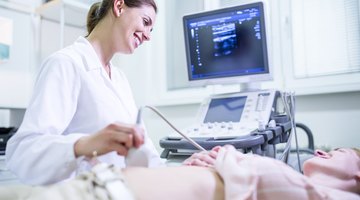

Ultrasound technicians, also referred to as diagnostic medical sonographers, operate complex imaging equipment that uses ultrasonic waves to produce visual images of internal bodily structures for the purposes of diagnosis and treatment of various health conditions, diseases and injuries. There is currently only one accredited school in British Columbia that offers two training programs in ultrasound technology. In addition, the Southern Alberta Institute of Technology in Calgary, Alberta, offers a distance learning option combined with clinical requirements that may be fulfilled in either Victoria or Penticton, British Columbia.
Diploma of Technology in Diagnostic Medical Sonography
The British Columbia Institute of Technology offers a highly competitive Diploma of Technology in Diagnostic Medical Sonography. This full-time program received over 200 applications in 2010 and admits only 24 students per year. Candidates must hold at minimum, a high school diploma with upper-level courses in English, physics, biology and math, although most successful applicants also have post-secondary education and professional work experience. This two-year program consists of theoretical, laboratory and clinical training in ultrasound procedures for the abdomen, female reproductive system, vascular system and heart. Course topics include anatomy, sonographic physics, cardiovascular sonography, pathophysiology, abdominal and superficial ultrasound, patient care and women’s health.
British Columbia Institute of Technology 3700 Willingdon Avenue Burnaby, BC V5G 3H2 866-434-1610 http://www.bcit.ca/
Advanced Specialty Certificate in Adult Echocardiography
The British Columbia Institute of Technology also offers an Advanced Specialty Certificate in Adult Echocardiography through online distance learning. Applicants must be practicing diagnostic medical sonographers with certification by the American Registry for Diagnostic Medical Sonography (ARDMS) or the Canadian Association of Registered Diagnostic Ultrasound Professionals (CARDUP). Coursework includes cardiology anatomy and physiology, cardiac pathophysiology, ultrasound physics, applied echocardiography and a practicum. All course materials and assignments are delivered through an online learning platform with the exception of examinations that must be written on campus.
British Columbia Institute of Technology 3700 Willingdon Avenue Burnaby, BC V5G 3H2 866-434-1610 http://www.bcit.ca/
Diploma in Diagnostic Medical Sonography
The Southern Alberta Institute of Technology (SAIT) offers a 26-month diploma program in diagnostic medical sonography. Candidates must have high school diplomas with upper-level coursework in English, biology, physics, chemistry and math. Successful applicants must also obtain certification in cardiopulmonary resuscitation (CPR) before beginning their studies. This program consists of theoretical and laboratory instruction in obstetric and gynecological ultrasound and sonographic procedures for the cardiac and vascular systems, abdomen, and superficial structures. Additional course topics include anatomy and physiology, patient care, equipment protocols and diagnostic scanning. Students in British Columbia have the option of completing formal coursework through online distance learning and fulfilling clinical practice requirements in Victoria and Penticton, British Columbia.
Southern Alberta Institute of Technology 1301-16 Avenue NW Calgary, AB T2M 0L4 877-284-7248 http://sait.ca/