Sidewinder Snake Facts

Sidewinder Snake Facts thumbnail
Sidewinders (Crotalus cerastes) are sit-and-wait predators

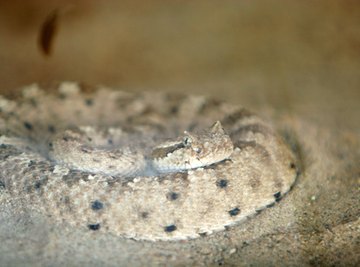
The sidewinder, Crotalus cerastes, belongs to the subfamily Crotalinae. These are also known as pit vipers, and the group includes rattlesnakes. Sidewinders have the typical attributes of other rattlesnakes, including a rattle, but they can be easily distinguished from them by the presence of large, hornlike structures above the eyes. Adults are small and typically only 1.5 to 2 feet long, but they are capable of growing to more than 2.5 feet in length.

  1. Geography and Habitat

    • Sidewinders are reptiles of the southwestern deserts of North America; they are restricted the southwestern U.S. and northwestern Mexico. In the U.S., sidewinders range from the lower, eastern half of California, through southern Nevada, to the southwestern tip of Utah and western Arizona. In Mexico, sidewinders can be found in eastern Baja California and western Sonora. Sidewinders favor deserts with loose, wind-blown sand at low elevations (below sea level to about 5,900 feet), especially if the sand is topped with vegetation such as the creosote bush. Other suitable desert habitats include areas with hardpan, gravel or rocky substrates.

    Locomotion

    • The common name "sidewinder" alludes to this snake's distinguished style of sideways locomotion (side-winding), which it uses to gain traction while moving over loose sand. Side-winding involves moving the body sideways in a series of S-shaped curves, while only allowing a few points of the body to contact the hot sand each time. Sidewinders leave a distinguishable series of parallel J-shaped tracks, with the hooks of the "J"s pointing in the direction of travel.

    Diet

    • Sidewinders are sit-and-wait predators that feed primarily on small rodents and lizards of the desert. Sidewinders ambush most of their prey outside the entrances of rodent and lizard burrows, where they wait partially buried (sometimes with only their head and back exposed) for the prey to emerge. Adults eat mostly small rodents and lizards, but will occasionally consume small birds and snakes. Neonates and small juveniles, on the other hand, feed almost exclusively on lizards.

    Reproduction

    • Mating takes place in either the spring or fall, with most mothers giving birth to their young in August, September or October. Sidewinders give birth to litters that range in size from one to 20 offspring, with most litters containing seven to 12 babies. The average length of a baby sidewinder is about seven inches, and they weigh about six grams.

    Predators

    • Although venomous, sidewinders--especially young ones--have numerous predators. Mammalian predators include kit foxes and coyotes, which can be abundant in some areas. Large predatory birds--kestrels, hawks, owls, roadrunners, ravens, shrikes and others--are also common predators of sidewinders. Sidewinders also fall prey to a number of reptile species, such as leopard lizards, coachwhip snakes, rosy boas and other, larger sidewinders.

Related Searches:

References

  • Photo Credit desert sidewinder rattlesnake image by MAXFX from Fotolia.com

Comments

You May Also Like

  • Sidewinder Snake Information

    The sidewinder is a rattlesnake that has made distinct adaptations to the hot, desert regions it inhabits in the United States and...

  • How to Identify a Sidewinder Snake

    Sidewinder Snakes are a common inhabitant of the deserts of the American southwest. The three species of Sidewinder Snake, the Sonoran Sidewinder,...

  • How Poisonous Is a Sidewinder Snake?

    The desert sidewinder (Crotalus cerastes) is a venomous pit viper native to the deserts of southwestern United States and northern Mexico. Like...

  • What Is the Sidewinder Snake's Population?

    Three species of sidewinder snakes live in the United States. They are the Mojave Desert Sidewinder, the Colorado Sidewinder and the Sonoran...

  • Sidewinder Snake Adaptations

    Sidewinder rattlesnakes, or crotalus cerastes, are native to the arid desert regions of the southwestern United States. They are particularly adapted to...

  • Sidewinder Rattlesnake Information

    The sidewinder, also known as Crotalus cerastes, is a desert rattlesnake found in Arizona, Nevada and California. According to the San Diego...

  • What Are Sidewinders' Enemies?

    Reaching lengths of between 3 and 6 feet (1 to 2m), the common king snake is a constrictor, subduing its prey by...

  • Sidewinder Rattlesnake Diet

    The desert sidewinder (Crotalus cerastus) exists in the Southwest, in states such as California, Arizona, Utah, and Nevada and in portions of...

  • Facts on Sidewinder Rattlesnakes

    Sidewinder rattlesnakes (Crotalus cerastes) are native to the American Southwest and northern Mexico, specifically in the Mojave and Sonoran Deserts. Sidewinders are...

  • Facts on the Sidewinder Rattlesnake

    Three subspecies of sidewinder rattlesnake exist in the United States, a snake that takes its name from the way it moves. Sidewinders...

  • How To Do The Sidewinder Yo-Yo Trick

    How to do the sidewinder Yo-Yo trick in this free yo-yo video.

  • Three Interesting Facts on the Green Water Snake

    Could you identify a green water snake if you saw one? This non-venomous snake, Nerodia cyclopian, is found in Florida, coastal South...

  • Habits of the Diamondback Rattlesnake

    Both species of diamondback are ambush predators, using venom to subdue prey. The snakes hide in a coiled position amid high grasses...

  • Rattle Snake Information

    The rattle snake--more often spelled as one word, "rattlesnake"--is a venomous snake of the pit viper subfamily. There are roughly 30 species...

  • How to Identify a Sonoran Desert Snake

    The Sonoran Desert sidewinder is a type of rattlesnake found in Mexico, California, Arizona, Nevada and Utah. They are of small stature,...

  • About Sidewinders

    The sidewinder rattlesnake is unique to North America, although there is a snake in Africa that does move in a similar manner...

  • Why Does a Rattlesnake Rattle Its Tail?

    The rattle is intended to warn off potential predators or dangerous animals. According to the Arizona-Sonora Desert Museum, the rattle is incredibly...

  • Snakes in Southeast Colorado

    Although most of the snakes found in the grassy lands of southeastern Colorado do not inject poison when biting, there are a...

  • What Is a Natural Enemy of Snakes?

    Snakes can be found all around the world, in many different colors, shapes and sizes. Although feared by many humans, snakes are...

  • Kinds of Rattlesnakes

    About 16 types of rattlesnakes, broken into 29 or 30 individual subspecies, occur in North, Central and South America. All have varying...

Related Ads

Featured