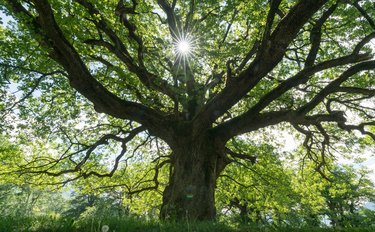
There are many types of oak trees that grace landscapes with their impressive height and value as shade trees. Live oak (Querus virginiana) a large, sprawling shade tree found widely in the American Southeast, is a long-living shade tree often found along urban streets. Laurel oak (Quercus laurifolia) also native to the Southeast, is a slightly smaller shade tree with shorter longevity. Although both of these trees are species in the same plant genus, they have some differences in appearance as well as cultural preferences.
Size, Age and Climate
Video of the Day
Live oak grows from 40 to 80 feet tall, spreading from 60 to 100 feet wide in U.S. Department of Agriculture plant hardiness zones 8 through 10. Laurel oak is a perennial in USDA zones 7 through 9, where it grows to a height of 40 to 60 feet with an equal spread. Healthy laurel oaks live from 50 to 150 years, but live oaks live more than 150 years.
Video of the Day
Salt and Soil Tolerances
Live oaks and laurel oaks are adaptable to different types of soil, including sand, silt and clay. Both species also tolerate wet soil, although live oaks can handle wet soil for extended periods of time and laurel oaks tolerate only occasional wet soil.
Live oak has a high tolerance for salt, making it good for coastal areas. Laurel oak does not tolerate salt.
Live oaks grow well in urban areas suffering from drought, compacted soil, poor drainage and air pollution. Laurel oaks, native to the edges of swamps, rivers and streams, do not tolerate urban conditions as well as live oaks.
Growth Habit and Pruning Needs
As the live oak grows, its drooping branches require pruning to make way for people and vehicles. You'll need to prune a live oak annually for the first three years after planting, then once every five years until it's 30 years old. Branches with a narrow angle to the trunk need to be pruned to prevent them from splitting as they get older.
Laurel oaks also have drooping branches that require pruning. To prevent their brittle wood from breaking, laurel oak branches should be pruned to keep their diameter to less than half of the width of the trunk. In dry conditions, laurel oaks grow more slowly, but with stronger wood that's less apt to break.
When oaks are older and larger, you'll need to call on a certified arborist for your pruning needs. But while the trees are still young and small, use a pruning saw or a pole pruner to shape them. Wipe the cutting blades with 70 percent isopropyl alcohol before making each cut to minimize the spread of disease.
Potential Oak Problems
The roots of live oaks can interfere with mowing and lift sidewalks. The surface roots of laurel oaks typically pose no problem to sidewalks or building foundations. Although laurel oaks grow to 50 to 70 years, decay and wood rot begin hollowing their trunks and large branches in roughly 50 years. Live oaks resist this decay and can live for centuries.
Flowers and Fruit
As part of the life cycle of oak trees, live oak and laurel oak trees have flowers, even though they are so inconspicuous that they're not often visible. Each tree has separate male and female flowers, and both trees bear acorns, which are the fruit of these oak trees, measuring 1/2 inch to 1 1/2 inches long. They vary slightly, however, in when the acorns are produced. Live oak's acorns mature in summer or fall, and laurel oak's acorns mature in fall or winter.