Wild blue poison dart frogs (Dendrobates tinctorius) are only found in a few of the remaining rainforests in the Sipaliwini savanna of southern Suriname, one of the countries that border Brazil. The Sipaliwini savanna was thought to be all rainforest until the last ice age.
Today, it is mostly grasslands. However, a few patches of rainforests remain where the groundwater level is higher. Blue poison dart frogs were formally known as Dendrobates azureus, but DNA testing found them to be a morph of and not a separate species to D. tinctorius.
Blue Poison Dart Frog Appearance
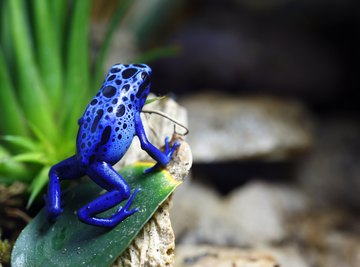
As you can see from the picture of a poison dart frog, they are bright blue with black spots all over their bodies. Their legs and belly are a darker blue than their back and head. Their bright coloration is thought to be a warning to predators signaling that they are poisonous.
Male and female blue poison dart frogs look very similar; however, females tend to be a little bit bigger at 1.77 inches (4.5 cm) while the males are only 1.57 inches (4 cm).
Blue Dart Frog Diet
Like the strawberry poison dart frog (Oophaga pumilio), blue dart frogs derive their protective poison from eating arthropods that are high in toxic compounds called lipophilic alkaloids. The ants they eat in the wild are particularly high in these chemicals.
As insectivores, they eat all insects including ants, spiders, mites, flies, beetles, termites and caterpillars. A lack of lipophilic alkaloids in the insects they are fed in captivity means they lose their poison.
Blue Poison Dart Frog Life Cycle
Like all frogs, poison dart frogs hatch from eggs, then undergo an aquatic larval stage as tadpoles before transforming into frogs through a process called metamorphosis. During metamorphosis, the thyroid gland secretes a growth hormone called thyroxine.
This hormone triggers the larvae to grow legs, reabsorb its tail and remodel organs to form an adult frog. The adult frog then goes on to live a terrestrial or semi-terrestrial life.
Courtship Behaviors
To find a female, the males will sit on a rock or leaf and quietly call to attract a mate. If more than one female finds the male, they will fight over him.
The winning female then uses her forelimbs to stroke the male's snout and back. Males and females may also wrestle one another during courtship.
Blue Dart Frog Breeding
Once a male and female pairs, the female follows the male to a sheltered area where they mate, and she lays the eggs.
Before she lays her eggs, both sexes take time to clean and moisten the area. She will lay between five and 10 eggs per clutch.
Tadpole Development
The tadpole eggs develop for 14 to 18 days in the place they were laid. When they are ready to hatch, the mother carries them on her back to a small body of water. The tadpoles new watery home may be inside a bromeliad, a leaf axil or in a small hole in a tree.
The mother visits her babies often to lay unfertilized eggs for them to eat. Blue poison dart frog metamorphosis spans 10 to 12 weeks. Once they are froglets, the mother leaves them to fend for themselves.
Blue Dart Frog Lifespan
Blue dart frogs reach sexual maturity at two years of age. Wild blue dart frogs tend to live between four and six years. In captivity blue dart frogs typically live around 10 years but have been recorded surviving to 12 years old.
Despite being poisonous, these little tree frogs are vulnerable to predation by snakes and big spiders. Dragonfly larvae may also eat the tadpoles.
References
About the Author
Adrianne Elizabeth is a freelance writer and editor. She has a Bachelor of Science in Ecology and Biodiversity, and Marine Biology from Victoria University of Wellington in New Zealand. Driven by her love and fascination with all animals behavior and care, she also gained a Certificate in Captive Wild Animal Management from UNITEC in Auckland, New Zealand, with work experience at Wellington Zoo. Before becoming a freelance writer, Adrianne worked for many years as a Marine Aquaculture Research Technician with Plant & Food Research in New Zealand. Now Adrianne's freelance writing career focuses on helping people achieve happier, healthier lives by using scientifically proven health and wellness techniques. Adrianne is also focused on helping people better understand ecosystem functions, their importance, and how we can each help to look after them.
Photo Credits
Brandon Alms/iStock/Getty Images