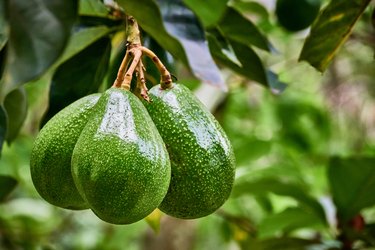
Avocado trees (Persea americana) are evergreen and grow in U.S. Department of Agriculture plant hardiness zones 8 through 11. Their three groups, called "families," are named for the areas where they were first cultivated domestically: Mexican, Guatemalan, and West Indian. Mexican avocados are the most cold-tolerant family.
It is best to purchase an avocado tree that has been grafted onto rootstock. Doing so will result in fruits three to five years from when you plant it. It is possible to grow an avocado tree from seed, but doing so means a five- to 13-year wait for fruit. You may also be in for a surprise, as the fruit you get may not be what you were expecting due to cross-pollination.
Video of the Day
Video of the Day
Planting an Avocado Tree
When you plant an avocado tree, timing matters. The plants like warm soil and direct sunlight, but young trees can suffer from sunburn. For best results, plant your tree sometime between March and June, before the summer sun is at its brightest. Avocados need full sun and lots of headroom: Mature plants can reach 60 feet or more in height, depending on the variety. Make sure your tree has enough room to grow.
Avocados need well-drained soil. If your soil is heavy or drains slowly, build a mound of soil about 2 feet high and 5 feet around to help improve drainage. Once you've picked the perfect spot, dig a hole deep enough to accommodate the plant's entire root ball. Make the hole a bit wider than necessary so you have room to get your hands into it. Carefully place the avocado plant in the hole, being extremely gentle with the tender roots; disturb the avocado's roots as little as possible during planting. Once you've seated the plant, backfill the planting hole and tamp down the soil.
Mulching Your Tree
Avocado trees have shallow roots that benefit greatly from mulching. Immediately after planting your avocado tree, spread coarse mulch around it. The best mulch for avocados is wood, with pieces about 2 inches in diameter. Cocoa bean and tree bark mulches are both excellent options. Make the mulch about 6 inches deep and keep it 6 to 8 inches away from the trunk of the tree.
Watering an Avocado
Like most plants, avocados need a deep watering immediately after planting. Always thoroughly soak the soil around your avocado tree when watering and then give the soil a chance to dry before watering the plant again. Test the soil before watering by scooping up a handful and squeezing it. If it holds its shape, skip the watering. If the soil crumbles when you let it go, it's safe to water your tree.
Young trees may need to be irrigated as often as two to three times per week, but always perform a soil check, because avocados dislike wet feet. Your tree will need watering less often — about once a week — when it reaches a year in age. Young trees hold about 2 gallons of water in their roots and use 1 per day. Mature trees need about 20 gallons of water a day during the growing season.
Feeding Your Tree
Do not fertilize your avocado tree until it is a year old. Fertilizing too soon may damage your young plant. When you do begin to fertilize your tree, use a balanced fertilizer that is equal parts nitrogen, phosphorous, and potassium (labeled as NPK on the fertilizer packaging). Look for a fertilizer that is labeled as 10-10-10 or 15-15-15. A 10-10-10 combination indicates that your fertilizer is 10 percent nitrogen, 10 percent phosphorous and 10 percent potassium.
Your tree will need 1 pound of actual nitrogen per year. To determine how much nitrogen your tree receives, multiply the weight of your fertilizer bag by the percentage of nitrogen it contains. This tells you how many pounds of nitrogen are in the bag of fertilizer. A 10-pound bag of 10-10-10 fertilizer contains 1 pound of nitrogen. (10 pounds x .10 = 1) You can also use an online calculator. It does not matter if you apply the fertilizer once or divide it into several smaller applications, as long as the tree receives 1 pound of actual nitrogen.
Avocado trees are often zinc-deficient and may need a zinc supplement in addition to fertilizer. To correct this deficiency, spread 1/2 pound of zinc sulfate around your tree once a year and water it in. You can find zinc sulfate at your local garden center or farm supply store.
Harvesting the Fruit
Harvest time varies from one avocado family to the next. All avocado plants produce yellow-green flowers before bearing fruit. Plants in the West Indian family bloom in the spring and produce fruit in the summer. Guatemalan plants, too, bloom in the spring, but do not produce fruit until the spring or summer of the following year. Mexican avocado plants bloom in the winter and then produce fruit in the summer or fall.
Avocados should never be allowed to fully ripen on the tree, because this results in mushy, foul-tasting fruit. Pick too soon, however, and the avocados may never ripen. Pick your avocados when they've just begun to soften and their skin dulls, losing its glossy appearance. If you're unsure, pick a single fruit and place it in your kitchen. If it's mature, it will ripen in three to eight days, and you'll know it's harvest time.
Avocados in Containers
The Wurtz avocado variety, frequently referred to as 'Little Cado,' is the only true dwarf avocado tree variety. The 'Little Cado' reaches a height of only 10 feet and grows well in large containers. The tree will need indirect sunlight when it is young but will be able to shade itself once its canopy fills in. Plants grown in containers also dry out more quickly, so check soil moisture levels more frequently than you would for an outdoor plant.
Avocado plants all produce both male and female flowers, opening one in the morning and the other in the afternoon. This makes it possible for an avocado tree to fertilize itself and produce fruit, but there is no guarantee of this since the flowers open at different times. If you want your container-grown avocado to fruit, try setting it outdoors during the flowering season. If you live too far north for outdoor plants, try growing another small avocado plant indoors to increase the likelihood of fertilization. Be aware, however, that avocado plants grown indoors may not fruit consistently or at all.