The Life of a Judgment on a Credit Report
Failing to make timely payments to unsecured creditors, such as your credit card company or bank, can result in an eventual judgment appearing on your credit report. A judgment can significantly damage your credit rating and make you a higher risk to future lenders with whom you apply for credit and loans.
-
Facts
-
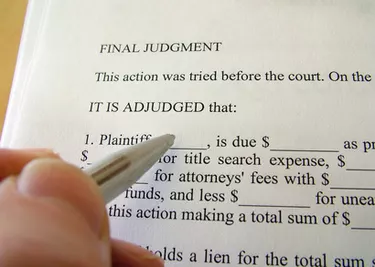
A court judgment is the official ruling of a judge following a lawsuit. If you're sued for unpaid debt, the creditor will notify you of the lawsuit via a summons. Should you not appear at the court hearing, or appear but fail to prove your case, the court will award a judgment to the plaintiff. A judgment gives a creditor the right to enforce collection by obtaining a wage garnishment order, bank levy or property lien against you. It also damages your credit.
Significance
-
Courts don't actively report legal rulings to the credit bureaus, nor does your creditor need to report the judgment. A record of the judgment in your case will be updated to computer databases that are searchable by the public. In most cases, the court ruling will appear in a regional database and in PACER, the national database. The credit bureaus' computer systems regularly search these databases for new public records, such as judgments and bankruptcies. If any new public records appear that can be matched to you within the credit bureaus' systems, each bureau will add the record to your credit report.
-
Time Frame
-
According to the Fair Credit Reporting Act (FCRA), a judgment may remain on your credit report for up to seven years from the date of the court ruling that created it. If the statute of limitations for judgment enforcement in your state is shorter than the seven-year reporting period, the FCRA states that the judgment may be removed as soon as the statute of limitations expires. You shouldn't confuse the statute of limitations for judgment enforcement with the statute of limitations for debt collection, as these two time frames may differ considerably depending on the state.
Misconceptions
-
Many states allow creditors to renew unpaid judgments for an additional term. This term, however, has no effect on the federal reporting period of the judgment on your credit report. California, for example, enforces initial judgments for a period of 10 years. If the debtor fails to pay off the judgment within that 10-year period, the creditor may renew the judgment for an additional 10 years. If the credit bureaus remove a judgment from your credit report, the creditor renewing the judgment will not result in it reappearing on your credit report.
Considerations
-
If you can prove that a the court awarded your creditor a judgment in error, the court will vacate the judgment. Once a judgment has been vacated, it's no longer in effect. You must provide evidence to the court proving that you're either not the individual who owes the debt, were not properly notified of the original lawsuit by the creditor or that technical errors in the way the lawsuit was filed render the judgment invalid. If you're successful in having your judgment vacated, you can then dispute the judgment with the credit bureaus and have it removed from your credit history before the reporting period expires.
-
References
Resources
- Photo Credit gavel image by Cora Reed from Fotolia.com