
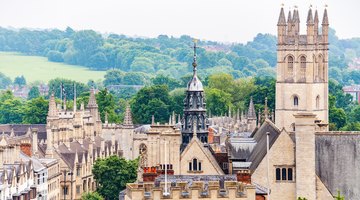


The Association of Commonwealth Universities is a member organization for institutions of higher learning in the British Commonwealth. Universities anywhere in the Commonwealth, including those in the United Kingdom, must be approved by government authority to provide higher education and award degrees, and must meet certain criteria for viability in order to join the ACU. The list of ACU universities in the UK contains some of the most venerable, top-ranking institutions of higher learning in the world.
University of Oxford
Oxford currently ranks #1 in the annual Times Good University Guide, its habitual ranking. It is the oldest school in the UK; teaching there dates from the 11th century although the exact founding date is lost in history. Oxford has more than 40 self-governing colleges and halls and is today as well known for its science and technology as for its classics departments. The university has produced 25 British prime ministers, at least thirty other international leaders and twelve saints, among other distinctions. As the home of the Rhodes scholarship, it has traditionally accommodated exceptional foreign students.
University of Oxford University Offices Wellington Square Oxford OX1 2JD United Kingdom +44-1865-270000 ox.ac.uk
University of Cambridge
The University of Cambridge is 800 years old and is composed of 31 colleges that include more than 150 departments, faculties, schools and other institutions. It consistently ranks with Oxford at the top of lists of leading universities worldwide. Cambridge claims 87 Nobel laureates among its alumni, a world record. Each of the colleges is an independent institution but all function as an extended family for their enrolled students who live in campus accommodations during their course of study. Cambridge has an extremely low drop out rate; students are personally mentored and encouraged to share ideas and innovations across disciplines, leading to the Cambridge reputation as a center for both successful start-ups and distinguished scholars. International applicants are welcomed.
The Old Schools, Trinity Lane, Cambridge CB2 1TN UK +44-1223-337733 cam.ac.uk
The University of Edinburgh
The University of Edinburgh was founded in 1582 and today ranks consistently among the top twenty universities in the world. During the 18th century, the university was at the forefront of the European Enlightenment and today it is a leading research institution. It is divided into three main colleges: Humanities and Social Science, Medicine and Veterinary Medicine, and Science and Engineering. Edinburgh, the capital of Scotland, is a sophisticated historic city and the university is a popular choice for international students.
The University of Edinburgh Old College, South Bridge Edinburgh EH8 9YL +44 (0)131 650 1000 ed.ac.uk
Cardiff University
Cardiff University is the top university in Wales and a world leader in research. It has a school of medicine, extensive humanities program and a top-ranking school of architecture among its 29 academic schools and four graduate schools. Cardiff University has more than 1000 international students enrolled, from 300 countries.The city itself is the capital of Wales, one of the most affordable cities in the UK, and home to world class opera and rugby.
Cardiff University Cardiff, Wales UK CF10 3XQ +44-029-208-74000 cardiff.ac.uk
Related Articles








References
Writer Bio
Benna Crawford has been a journalist and New York-based writer since 1997. Her work has appeared in USA Today, the San Francisco Chronicle, The New York Times, and in professional journals and trade publications. Crawford has a degree in theater, is a certified Prana Yoga instructor, and writes about fitness, performing and decorative arts, culture, sports, business and education .