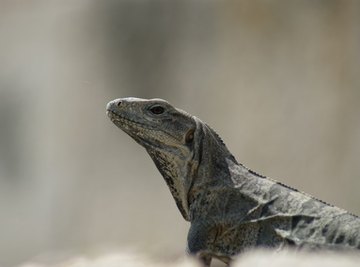
Reptiles are from the animal class Reptilia while amphibians are from the class Amphibia.
Reptilia contains the New Zealand tuatara (Sphenodontia), snakes (Squamata), turtles (Testudinata), lizards (Squamata) and crocodiles (Crocodilia).
Amphibia contains frogs (Anura), caecilians (Gymnophiona), salamanders and newts (Salamandridae). Reptiles and amphibians are found all across the globe except for Antarctica.
Amphibians vs. Reptiles: Similarities
Amphibians and reptiles share many similarities. One of the similarities between reptiles and amphibians is that they are both ectotherms, which means they rely on their environment to control their body temperature.
Another similarity is that many, not all, are omnivores or insectivores. All reptiles and amphibians have four legs (except for legless lizards in the Pygopodidae family and caecilians) and a tail (except for frogs).
Many reptiles and amphibians use toxins or poisons as a defense mechanism from predators. The blue poison arrow frog (Oophaga pumilio) in the Amazon sequesters alkaloids from the ants and arthropods in their diet to produce chemical defenses that deter pathogens and predators.
Many snakes, particularly from the Elapidae, Viperidae and Atractaspididae families, deliver toxic venom from their fangs as both a protective mechanism and to help them catch their prey. Similarly, iguanas (Iguaninae) have a weak, mostly harmless, venom that can cause serious damage in the rare event that an iguana bites.
Amphibians vs. Reptiles: Differences
A significant difference between amphibians and reptiles is that amphibians have semi-permeable skin while reptiles have scales. Reptiles scales also help them survive in dry landscapes where amphibians heavily rely on water in their environment to stop them from drying out.
Amphibians use their porous skin and lungs for respiration. Reptiles purely use their lungs for respiration.
Another difference is that amphibians circulatory system features a partially divided atrium in the heart. This partial division means that amphibians only have partially oxygenated blood pumping to the body from their heart. In contrast, reptiles have a clearly divided atrium, which means that they only have aerated blood pumping through their bodies.
Reproductive Similarities and Differences
Reptiles and amphibians are both animals, many of which have internal fertilization. They both lay eggs. However, reptile eggs tend to have a harder shell while amphibians have soft, permeable eggs, more like fish eggs.
A big difference in their development is that amphibians have an aquatic larval form after hatching. This larval form, think frog tadpoles, undergoes metamorphosis before reaching adulthood.
Reptiles do not have any larval stage; they have their adult form as soon as they hatch from the egg then undergo a series of skin shedding events as they grow.
Amphibian and Reptile Sizes
Both reptiles and amphibians come in a wide range of sizes.
The largest living reptiles are reticulated pythons (Python reticulatus), which can reach lengths of up to 29.5 feet (9 meters) with weights of up to weigh 595 pounds (270 kilograms). Saltwater crocodiles (Crocodylus porosus) are the heaviest weighing up to 2,646 pounds (1200 kilograms) and growing up to 23 feet (7 meters) long.
In contrast, the largest living amphibian is the Chinese Giant Salamander (Andrias davidianus), which can reach up to 4.9 feet (1.5 meters) long and weighs 25 pounds (11.3 kilograms). The largest frog is the African Goliath Frog (Conraua goliath), which reaches up to 1 foot (32 centimeters) long and weighs more than 6.6 pounds (3 kilograms).
One of the smallest animals in the reptile family are dwarf geckos (Sphaerodactylus parthenopion), which reach a mere 0.6 to 0.7 inches (16 to 18 millimeters) long and have a mean body weight of only 0.0041 ounces (0.117 grams).
However, the Amphibia family wins the award for the worlds smallest vertebrate in the world. The tiny frog, Paedophryne amauensis, found in the forests of Papua New Guinea is only 0.3 inches (7.7 millimeters) long.
References
- Encyclopaedia Britannica: Amphibians
- Encyclopaedia Britannica: Reptiles
- Tree of Life: Chordata
- Saint Louis Zoo: Amphibians
- Saint Louis Zoo: Reptiles
- Encyclopaedia Britannica: Reptile Circulatory System
- Journal of Chemical Ecology: Sequestered Alkaloid Defenses in the Dendrobatid Poison Frog Oophaga pumilio Provide Variable Protection from Microbial Pathogens
- Handbook of Clinical Toxicology of Animal Venoms and Poisons: Biology and Distribution of Venomous Snakes of Medical Importance and The Composition of Snake Venoms
- Encylopaedia Britannica: Reptiles Size Range
- Amphibia Web: Amphiban Facts
- Animal Diversity Web: Python Reticulatus
- Animal Diversity Web: Crocodylus Porosus
- Comparative Biochemistry and Physiology Part A: Physiology: Water-Loss Rates of Sphaerodactylus Parthenopion (Reptilia: Gekkonidae), The Smallest Amniote Vertebrate
- Zoo and Wild Animal Medicine: Anurans
- Encyclopaedia Britannica: 7 of the World's Most Dangerous Lizards and Turtles
About the Author
Adrianne Elizabeth is a freelance writer and editor. She has a Bachelor of Science in Ecology and Biodiversity, and Marine Biology from Victoria University of Wellington in New Zealand. Driven by her love and fascination with all animals behavior and care, she also gained a Certificate in Captive Wild Animal Management from UNITEC in Auckland, New Zealand, with work experience at Wellington Zoo. Before becoming a freelance writer, Adrianne worked for many years as a Marine Aquaculture Research Technician with Plant & Food Research in New Zealand. Now Adrianne's freelance writing career focuses on helping people achieve happier, healthier lives by using scientifically proven health and wellness techniques. Adrianne is also focused on helping people better understand ecosystem functions, their importance, and how we can each help to look after them.
Photo Credits
REPTILE image by sylvie BRELOT-FORMENTO from Fotolia.com