What Does Gold Ore Look Like?

What Does Gold Ore Look Like? thumbnail
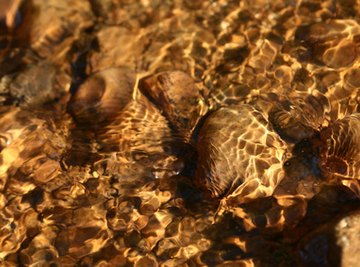
Gold ore can travel down rivers and streams.

To the untrained eye, gold ore may look like rock with copper tones flowing within it. However, professional prospectors know how to recognize gold ore within a multitude of minerals. Recognizing the look and the location of gold ore is easier if you know how to find lode and placer deposits. General descriptions of gold ore vary because gold travels when it is exposed to the elements.

  1. The Basics

    • Lode deposits of gold containing minerals are the result of volcanic activity, so minerals like quartz may appear near gold. Another type of gold ore is the result of cementing within hosts of sedimentary rocks after making its way down a river.

    Variables

    • The ways that gold collects in minerals will shape the look of gold ore. So if you are looking for big chunks of gold in gold ore, restrict your search to ore within lode deposits---these are the sites where tectonic activity brings gold into existence. Since gold originally forms in large veins, gold ore from these sites has an obvious amount of gold in them. If size does not matter, small flecks of gold are common within placer deposit gold ore. Placer deposits of gold ore may resemble the region's sedimentary rocks.

    Features

    • The absence of cleavage with the ore's gold is a notable feature. Evidence of quartz and sulfide minerals surrounding gold veins may be clear. Gold ore can look like quartz with streaks or spotty areas of gold.

    Expert Insight

    • The Environmental Protection Agency says that gold is commonly alloyed with silver and other metals. So indicators of the presence of sulfides like arsenic, copper, iron, and silver may also appear within gold ore.

    Misconceptions

    • A common misunderstanding about the appearance of gold ore is the idea that all gold ore contains visible pieces of shiny gold. While this is sometimes the case, spotting gold within gold ore rocks is occasionally impossible too. A jeweler's loupe can help you distinguish flecks of gold within gold-bearing ore bodies.

    Exceptions

    • Some forms of gold ore make recognizing its gold content challenging. For example, pyrite and arsenopyrite are carriers of invisible quantities of submicroscopic gold. Another obstacle to seeing gold in gold ore occurs when gold entwines with other metals within the ore. Such finely distributed particles of gold only become visible after tests reveal the ore is worthy of processing.

Related Searches:

References

  • Photo Credit water image by jeancliclac from Fotolia.com

Comments

You May Also Like

  • How to Identify Gold Ore

    Gold is a precious metal mined to create practical and ornamental pieces of work. Refined gold ore can be melted, poured and...

  • What Does Fake Gold Look Like?

    You are probably familiar with the saying "All that glitters is not gold." This is certainly true, but it has probably never...

  • What Does Spotting Look Like?

    Vaginal spotting can occur anytime during your reproductive and postreproductive years. It can be the sign of a medical problem, but in...

  • What Does Radon Look Like?

    Radon is an invisible radioactive gas. It is a product of the decay of radioactive ores, primarily radium, found in water, soil...

  • How to Test a Rock for Gold

    Imagine wading in a stream bed on a hot summer day and looking down to see a glimmering gold-like substance in the...

  • How to Look for Information About Gold Prospecting

    The quest for gold is practically as old as the human race itself. Finding gold is a combination of both art and...

  • What Is Gold Ore?

    Gold ore is a concentration of gold in rock, particles or flakes in water. Gold ore is only technically considered to be...

  • What Does Mulch Look Like?

    Mulch often comes in shredded or chipped form and will frequently be long and stringy. Use mulch to help conserve moisture and...

  • What Does a Roundworm Look Like?

    Roundworms are invasive parasites that can infect pets and even people if caution is not taken. A healthy, clean environment is the...

  • What Does a Tapeworm Look Like?

    Few things are as creepy as the thought of a parasite gaining entry to your body. Tapeworms are parasites that take up...

  • What Does an Aphid Look Like?

    Aphids are tiny, soft-bodied insects that are typically yellow, green or brown, with sucking mouth parts and cornicles. Identify aphids, which typically...

  • What Does Asbestos Look Like?

    Asbestos is the name given to a group of naturally mined fibrous silicates. Its is an extremely effective thermal and acoustic insulator,...

  • Places to Look for Placer Gold

    As water moves from higher locations to lower ones, the flow pushes along solid materials. Where the water slows, these materials slowly...

  • How to Process Gold Ore

    Gold can be found in quartz veins and ore throughout gold-bearing regions of the world. Ore is any mineral that contains enough...

  • What Does the Money Look Like in France?

    In 1999 the euro replaced the national currencies of many European countries, including France. Similar to traditional French currency, the franc, the...

  • Gold Ore Identification

    Thousands of years ago, the people of the first sub-Saharan Nubian kingdom were extracting gold from within gold ore rocks at a...

  • What Does an IUD Look Like?

    An IUD, or Intrauterine Device, is a device used for long term birth control. Although IUDs earned a bad reputation in the...

  • How to Identify Gold Rocks

    Gold! It conjures visions of hard prospectors searching through valleys and streams for gleaming metal. The fact is finding gold is (usually)...

  • How to Look Like a Gold Miner

    The year 1848 brought many visitors to California. However, the visitors were not in California to enjoy the Pacific Ocean. Each male,...

Related Ads

Featured