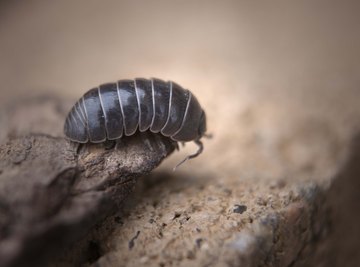
The little blue-gray critters that live under rocks and logs and roll into a ball when disturbed go by many names: roly-poly bugs, pillbugs, woodlice, tiggy-hogs, parson-pigs and their scientific name, Armadillidium vulgare. Contrary to popular belief, roly-polies are not even technically bugs. But they do play an important role in ecosystems.
TL;DR (Too Long; Didn't Read)
Roly-poly bugs are actually crustaceans. Their job in ecosystems is to decompose materials from dead plants and animals.
Classification Features
Even though their name implies that these little guys are bugs, they're not actually insects, but crustaceans. They're in the isopod (meaning same pod or foot) family and have seven pairs of legs that are all similar in size and shape. Roly-poly bugs also have three main body parts – head, thorax and abdomen – as well as simple eyes, uropods, a pair of prominent antennae, gills and lunglike adaptations. As terrestrial creatures related to marine animals, they need moisture to survive but cannot live submerged in water.
Life Cycle
Female roly-poly bugs may have one to three broods of young per year. When the eggs are formed, the female places them into a brood pouch where she may carry up to 50 eggs. In approximately two months, the young roly-polies emerge. They look like small roly-poly bugs, and if it is a species that can roll, it can do so at birth. These isopods molt up to a dozen times in their lifetime, and the average lifespan of a roly-poly is between two and five years.
Roly-Poly Adaptations
Roly-poly bugs have many unique adaptations. They have an exoskeleton with plates. They may not be able to bite or sting, but many are able to roll up into a ball for protection and also use odor as a defense. Roly-polies have even shown social behaviors such as fighting over food and communicating by tapping with their antennae. They absorb water with food, through mouth parts or by capillary action through their uropods. These cold-blooded critters react strongly to humidity levels, light and temperature changes. They like dark, moist areas, and if left out in the sun, they perish.
Ecosystem Roles
Roly-poly bugs are decomposers. They digest waste like scat as well as decaying matter from dead plants and animals, and then return the essential nutrients back into the soil. Because roly-polies are sensitive to changes in the environment, they also serve as biological indicators for the health of ecosystems. Additionally, roly-poly bugs are a food source for other animals.
Natural Insect Control
Often these harmless creatures are considered pests. Because they seek out dark, cool places and are decomposers, they may be found in decaying organic matter and in gardens. Generally, they don’t eat the plants but have been known to cause some damage to tender plants and roots. University of California entomology professor Lester Ehler discovered that roly-poly bugs eat the eggs of stink bugs. Since stink bugs can do considerable damage to crops, roly-polies may be beneficial for natural insect control.
References
About the Author
Julie Durr began her writing career in 2001. Her work has appeared online for "Wee Ones Magazine" and "Senior Citizens Magazine," as well as in a "Vocational Biography" and "Divine Stories of the Yahweh Sisterhood." Durr holds a Bachelor of Science in medical technology from Michigan Technological University.