
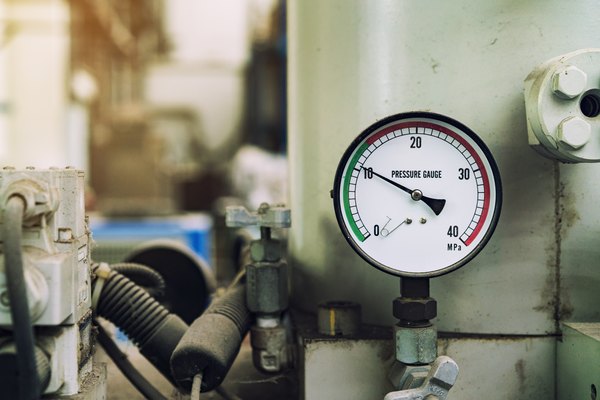
In your everyday life, you likely take for granted the fact that you’re surrounded by gases, generally in the form of air, but sometimes in other forms. Whether it is the bouquet of helium-filled balloons you purchase for a loved one or the air you put in the tires of your car, gases need to behave in a predictable manner for you to make use of them.
TL;DR (Too Long; Didn't Read)
Gases generally behave in a manner described by the Ideal Gas Law. The atoms or molecules making up the gas collide against each other, but they are not attracted to each other as with the creation of new chemical compounds. Kinetic energy is the type of energy associated with the motion of these atoms or molecules; this makes the energy associated with the gas reactive to changes in temperature. For a given quantity of gas, a drop in temperature will cause a drop in pressure if all other variables remain constant.
The chemical and physical properties of each gas differs from those of other gases. Several scientists between the 17th and 19th centuries made observations that explained the general behavior of many gases under controlled conditions; their findings became the basis of what is now known as the Ideal Gas Law.
The Ideal Gas Law formula is as follows:
where,
- P = absolute pressure
- V = volume
- n = number of moles
- R = universal gas constant = 8.3145 Joules per mole multiplied by Kelvin units of temperature, often expressed as "8.3145 J/mol K"
- T = absolute temperature
- N = number of molecules
- k = Boltzmann constant = 1.38066 x 10⁻²³ Joules per Kelvin units of temperature
- NA = Avogadro's number = 6.0221 x 10²³ molecules per mole
Using the formula for the Ideal Gas Law – and a little bit of algebra – you can calculate how a change in temperature would affect the pressure of a fixed sample of gas. Using the transitive property, you can express the expression:
Since the number of moles, or quantity of gas molecules, is held constant, and the number of moles is multiplied by a constant, any changes in temperature would affect pressure, volume or both simultaneously for a given sample of gas.
Similarly, you can also express the formula in a way that calculates pressure. This equivalent formula:
shows that a change in pressure, all other things remaining constant, will proportionally change the temperature of the gas.
References
About the Author
David Sandoval holds a degree in microelectronics, and has several years of experience in the technology field. He has written articles for eHow, Answerbag, and wiseGEEK in the disciplines of chemistry, electronics, and physics.
Photo Credits
Hemera Technologies/PhotoObjects.net/Getty Images