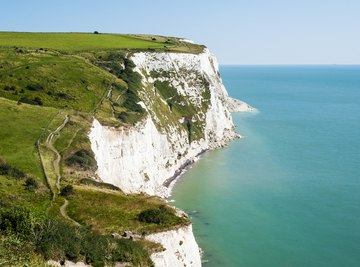
Cliffs are the steep rockfaces that frame valleys and many seas and oceans around the world. Cliffs generally feature a nearly vertical face, but there is no specific angle a rockface must have to be called a cliff. As landforms of erosion, cliffs are usually created over time but can sometimes fall apart in large chunks during extreme weather events. When water cascades over these rockfaces, waterfalls form, which also contributes to their erosion.
How Are Cliffs Formed?
Cliffs are generally formed in one of three ways: through weathering, through erosion, or from tectonic activity. Tectonic activity refers to the movement of the Earth's crust, and this kind of activity is responsible for notable cliffs like the White Cliffs of Dover. Tectonic activity can also lead to the formation of cliffs from escarpments.
As landforms of erosion, cliffs are created when natural weather events such as wind, rain or waves break tiny particles and pieces of soft rocks and minerals, called sediment, away from harder rocks. During these weathering events, the sediment is washed away by the rain or wave action. The bulk of the cliff is made up of the remaining harder rocks.
Larger rocks within the cliff may be dislodged during extreme weathering events. These events can cause the soft sediment surrounding them to gradually be removed, weakening their hold on the cliffside. When larger rocks break off, they tumble down the side of the cliff (in what's called a scree or talus) then build up at the bottom. The piles of rocks that collect at the bottom of cliffs are termed a scree slope or talus pile.
Famous Cliffs
Cliffs are found across the world, from the high mountaintops of the Himalayas to coastal regions that separate land from the ocean. As prominent landscape features, humans have used cliffs throughout time for navigation, separation of territories and protection. Some villages have even turned cliffs into their homes, like the Gila cliff dwellings of New Mexico, built in the 1280s.
The White Cliffs of Dover
The White Cliffs of Dover are coastal cliffs that span eight miles along the English Channel on either side of the town of Dover, England. At their highest points, they reach over 300 feet tall. Their striking appearance makes these cliffs one of Britain's most beloved and recognizable landmarks.
The cliffs began forming under the ocean around 70 million years ago. Small single-celled organisms with calcium carbonate skeletons called coccoliths filled the sea. When a coccolith died, its white calcium carbonate shell sunk to the seafloor. Around 0.02 inches of these coccoliths built up each year, resulting in a buildup of over 1,600 feet in some places.
Then plate tectonics took over. This movement of the Earth's crust shifted the mass of chalk out of the ocean. The British Isles were initially part of mainland Europe, but a glacial lake broke away during the last ice age and separated England from mainland Europe. This started the formation of the English Channel and, in turn, the White Cliffs of Dover. Since then, various weathering events have eroded the cliffs, and the coccolith chalk sediment is gradually returning to the ocean.
Other Notable Cliffs
Cliffs are one of nature's most impressive sights, and it's no wonder that tourists flock to witness the stark beauty of cliffs rising into the air. Some of the world's most popular tourist attractions are cliffs, including:
- El Capitan (United States)
- The Cliffs of Moher (Ireland)
- Trango Towers (Pakistan)
- Torres del Paine (Chile)
- The Amphitheatre (South Africa)
- Étretat (France)
- Thor Peak (Canada)
- Cape Enniberg (Faroe Islands)
- Mitre Peak (New Zealand)
- Rupal Face (Pakistan)
References
- National Geographic: Cliff
- National Geographic: Sediment
- Cliffs of Dover: The Geology of the Cliffs of Dover
- Dover Museum: White Cliffs of Dover
- Nature: The So-called 'Granite Axial Core' of the Himalaya
- The Geological Society: Continental/Continental: The Himalayas
- National Geographic: Climbers Make History Scaling Pakistan's ‘Killer Mountain’
About the Author
Adrianne Elizabeth is a freelance writer and editor. She has a Bachelor of Science in Ecology and Biodiversity, and Marine Biology from Victoria University of Wellington in New Zealand. Driven by her love and fascination with all animals behavior and care, she also gained a Certificate in Captive Wild Animal Management from UNITEC in Auckland, New Zealand, with work experience at Wellington Zoo. Before becoming a freelance writer, Adrianne worked for many years as a Marine Aquaculture Research Technician with Plant & Food Research in New Zealand. Now Adrianne's freelance writing career focuses on helping people achieve happier, healthier lives by using scientifically proven health and wellness techniques. Adrianne is also focused on helping people better understand ecosystem functions, their importance, and how we can each help to look after them.