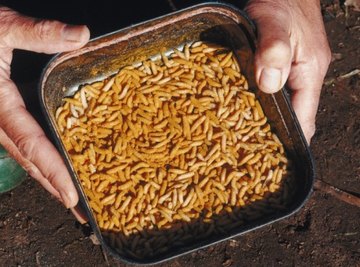
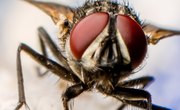
Fly maggots perform a vital decomposer function in ecosystems. Maggots help to break down dead material, returning nutrients back to the soil to be recycled. Maggots aren't just highly valuable to the environment - the maggot life cycle from egg to adult fly is a fascinating one.
The Life Cycle of Fly Maggots
After mating, a female fly lays up to 300 eggs in a clump of a suitable substrate, like in the decaying flesh of an animal, feces or rotting food. This provides the hatched larva (baby maggots) with plenty of food for their development. After hatching, fly maggots undergo five molting stages to reach adulthood. The time between each molt is called an instar. The time it takes to develop from eggs to flies is dependent on temperature, and this incubation period will typically last 17 to 28 days at a temperature of 68 degrees Fahrenheit.
Temperature-dependent development is a characteristic of poikilothermic animals like fly maggots. Poikilothermic animals' temperature regulation matches their environment. In warmer temperatures, their metabolic processes will be faster. In colder temperatures, they will move and develop more slowly. For example, Australian blowflies (Chrysomya rufifacies) incubated at 60 degrees Fahrenheit will take approximately 598 hours to become adult flies, but when incubated at 95 degrees Fahrenheit, maggots turn into flies in 190 hours.
Eating Machines
A fly's main time for eating is while they are instar maggots. Their mouths are full of hooks designed to devour flesh and their posteriors contain a chamber with an anus and structures called spiracles. The fly maggots use their spiracles for respiration, which keeps their mouths free for eating. Some predatory maggots, like Australian blowflies, feed on other maggots. These maggots have spikes covering their entire body to help protect them from others that might eat them.
First Instar Fly Maggots
Fly maggots typically only take one day to hatch after the eggs are laid. However some flies, like the common blowfly (Calliphora augur) from Australia, are ovoviviparous. In this case the first instar fly hatches from a membrane rather than from an egg, an event which happens almost instantly after the mother lays them. These freshly hatched little white maggots measure around 0.079 inches long and start feeding by sucking on the fluids of the meal their mother laid them on. As they feed, they begin to migrate further into their meal.
Second Instar Fly Maggots
Under optimal conditions, most fly maggots will molt from first instar to second instar fly once they reach around 0.2 inches long, which can happen within a day. Instar two continues to move around in the maggot mass feeding. It will take another day for instar two to grow to around 0.4 inches long, then molt its skin to develop into instar three.
Third Instar Fly Maggots
Fly maggots are bigger now and take a little longer (usually around two days) to transition from the third instar to their pre-pupa stage. The third instar continues to feed and move around in the mass of maggots. This is its last chance to bulk up and feed before becoming a pupa and then an adult. Third instar maggots will grow to between 0.6 and 0.79 inches long before entering their pre-pupa stage.
Pre-Pupa Fly Maggots
Pre-pupa maggots stop feeding. At this stage, they start to migrate away from their primary food source and find a satisfactory pupation place. Usually, they bury themselves somewhere in soil. Their pre-pupa to pupa phase typically takes around four days.
Pupa: Maggots Turn into Flies
The pupa stage is when the larval maggot turns into a fly. Flies are holometabolous, which means they undergo complete metamorphosis. Their larval and adult stages look completely different, similar to how a caterpillar turns into a butterfly. During the metamorphosis, also known as the pupation stage, their larval body completely degenerates. Then an air bubble escapes the pupa, filling their puparium and making space for their legs, head and wings to develop inside and form the framework for their adult body. At optimal temperatures, after around ten days, an adult fly emerges from its puparium.
References
Resources
About the Author
Adrianne Elizabeth is a freelance writer and editor. She has a Bachelor of Science in Ecology and Biodiversity, and Marine Biology from Victoria University of Wellington in New Zealand. Driven by her love and fascination with all animals behavior and care, she also gained a Certificate in Captive Wild Animal Management from UNITEC in Auckland, New Zealand, with work experience at Wellington Zoo. Before becoming a freelance writer, Adrianne worked for many years as a Marine Aquaculture Research Technician with Plant & Food Research in New Zealand. Now Adrianne's freelance writing career focuses on helping people achieve happier, healthier lives by using scientifically proven health and wellness techniques. Adrianne is also focused on helping people better understand ecosystem functions, their importance, and how we can each help to look after them.
Photo Credits
Jupiterimages/Photos.com/Getty Images