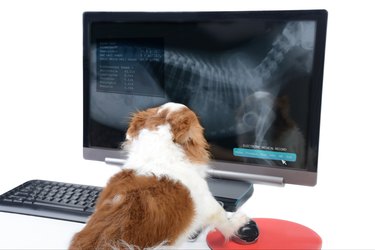
X-rays, known in medical terminology as radiographs, are a common diagnostic tool used by veterinarians to diagnose a variety of problems, including signs of cancer in dogs. Radiographs are most often used to identify obvious abnormalities, such as broken bones, ingested foreign material, or fluid accumulation within body cavities.
Video of the Day
However, radiographs are also an important tool for use in dogs diagnosed with or suspected of having cancer. Radiographs may be used not only to locate a tumor growing in a certain location but also to identify areas where cancer may have spread. There are also limitations to radiology that may make recommending a different test more appropriate.
Video of the Day
Dog X-rays of primary tumors
A tumor growth that begins in a certain location in the body and progresses to the point of forming a mass in that location is known as the primary tumor. Dogs may develop primary tumors in virtually any body part.
Radiographs are most likely to identify primary tumors in the chest (lung or heart), abdomen (liver, spleen, intestines, etc.), or bones (including skull, ribs, spine, and long bones). There are also less specific changes that may be seen on a radiograph that could indicate cancer when a tumor is not obvious. These include changes in organ size, fluid in a body cavity, evidence of bowel obstruction, and lymph node enlargement.
Radiographs of metastatic tumors in dogs
When the primary tumor spreads cancer cells to another part of the body, causing tumors to form in a new location, these are termed metastatic tumors, and the process of spread metastasis. Tumors in dogs often metastasize to the lungs, no matter where the primary tumor arose. Therefore, radiographs of the chest (commonly referred to as thoracic radiographs) are often performed in dogs with a confirmed or suspected diagnosis of cancer.
Other sites of metastasis include lymph nodes, bone, or other internal organs, all of which can be evaluated by radiographs. It is important to identify possible sites of metastasis, as this will determine how effective cancer treatment may be and will affect your dog's overall prognosis.
Limitations of radiographs of tumors in dogs
Although radiographs are a useful tool in diagnosing cancer in dogs and evaluating how far cancer may have spread, there are limits to what abnormalities radiographs can accurately detect. For example, a tumor in the liver or spleen may only manifest as enlargement of that particular organ without showing an actual mass or tumor. Small, scattered tumors throughout an organ that are not causing it to become enlarged may be undetectable on radiographs.
Your veterinarian may not be able to identify the organ of origin on a radiograph alone because many organs reside close together, often with overlap. In the front part of the abdomen, tumors of the liver, spleen, stomach, and possibly kidney can all appear very similar. Your veterinarian may recommend an ultrasound to evaluate the architecture of the organs, to yield more information about the origin of a tumor, and to offer treatment options.
Another limitation of radiology is in evaluating "protected" areas of the body, usually those covered by large amounts of bone. These areas cannot be fully evaluated because the radiographs only show the bony structures surrounding the area. The most common sites affected include the nasal cavity, the brain, and the spine and spinal cord. Advanced diagnostic imaging techniques, such as CT scans or magnetic resonance imaging (MRI), are often recommended to fully evaluate these areas. Your veterinarian will make the best recommendation for diagnostic tests based on your dog's type of cancer, the treatment options, and the location of the cancer.
The bottom line
X-rays can show tumors in dogs. X-rays are commonly used to reveal something inside your dog, as in the case of ingesting foreign objects (are you missing some Legos?), but radiography can reveal other issues like broken bones and soft tissue abnormalities such as blood vessel blockages, fluid in lungs, and digestive problems. In veterinary medicine oncology (cancer treatment), a DVM would use radiography to determine where a tumor is growing and where the cancer may have spread.