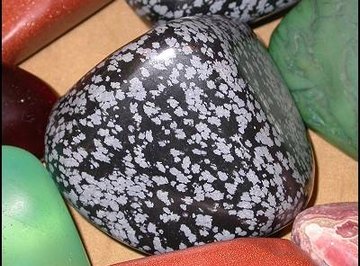
The appearance of white "snowflakes" on smooth, black obsidian has fascinated many people. Snowflake obsidian's appearance has caused many people to collect it or use it for metaphysical practices, believing the stone carries a powerful healing energy. It has also drawn many people to learn about the processes that formed the "snowflakes," which mark the transformation of volcanic glass into true rock.
Appearance
Obsidian, a dark volcanic glass, has a smooth, glossy appearance. Snowflake obsidian is a type of black obsidian with white or grayish spots. These spots are called spherulites, and they are composed of needle-shaped cristobalite, a type of quartz.
Formation
Obsidian forms when lava cools quickly. When lava cools more slowly, crystals begin to form, giving the rock a more textured appearance. Snowflake obsidian can form underground, in cracks that the magma seeps into, or above ground in slow-moving, silica-rich lava flows.
Composition
Obsidian's high silica content makes the lava it forms from highly viscous, or thick. It also has a low water content, since as the magma reaches the surface, most of the water evaporates as steam. The lava therefore moves quite slowly. The composition of obsidian can change over time, just as any type of rock changes over time, moving through different phases of the rock cycle. Over a long period of time, it changes into true rock. In this process, called devitrification, the silica molecules rearrange themselves into crystal patterns, as geologist Jim Miller of Oregon State University explains. As quartz crystals form, they can have the appearance of snowflakes, and the rock becomes known as snowflake obsidian. At this point, the formation of the crystals has caused it to lose its glassiness.
Uses
Obsidian has been used in many societies in making tools, but because snowflake obsidian is a true rock rather than a glass, it does not have the same smooth, sharp edge when it breaks. It is therefore less useful as a tool than obsidian itself. However, people sometimes use snowflake obsidian in metaphysical healing practices. Many people believe that holding obsidian or placing it on one of the chakras can help to balance the mind, body, and spirit. It is said to have a soothing energy that helps one to understand unhealthy behavioral patterns. Its ability to foster personal insights, overcome negative feelings and accept guidance that may be available, is said to make it a powerful healing stone. Many people collect it for its beauty and interesting appearance.
Geography
Snowflake obsidian forms in areas of past or present volcanic activity. These areas lie along the tectonic plate boundaries. It is found in many areas of the world where volcanic activity has taken place. In the United States, it is found on the West Coast, an area with high levels of tectonic activity. It also occurs where magma has a high silica content. It has a similar composition to granite and rhyolite, which also have a high silica content, but its much faster cooling rate creates its glassy texture.
References
About the Author
Melanie J. Martin specializes in environmental issues and sustainable living. Her work has appeared in venues such as the Environmental News Network, "Ocean" magazine and "GREEN Retailer." Martin holds a Master of Arts in English.