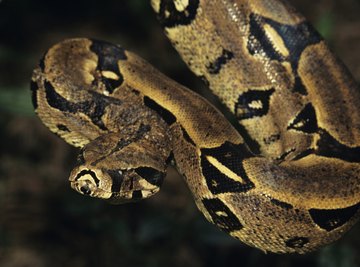
Boa constrictors (Boa constrictor) are large snakes that grow up to 13 feet long and can weigh up to 100 pounds. In the wild, boa constrictors live between ten and 30 years, but as pets they can live up to 40 years. Boa constrictors' habitat ranges from northern Mexico to northern Argentina and Peru, though they mostly live in tropical forests and open areas across Central and South America.
Boa Constrictor Fun Facts
Boa constrictors' locomotion is rectilinear, which means they move forward in a straight line instead of the common side-to-side slithering most people think about when they think of snakes moving. For rectilinear locomotion, boas tighten their ribs, then move their belly scales up and stretch them to move forward. Vipers and pythons are the only other two types of snakes that move this way.
Boa Constrictor Markings
Boa constrictor markings are distinctive. On their heads, they have three stripes. One stripe stretches from the tip of their snout to the back of their head, running between their eyes. Another stripe goes from their snout to their eye, and the third stripe is a triangle-shaped stripe starting at the far edge of their eye and running down to the back on their jaw.
Their backs are cream, tan or brown in color with darker saddle-shaped markings that become more colorful, sometimes reddish, down their tail. Across their entire body, boa constrictors have small dark spots. Juvenile boa constrictors' markings are usually more colorful than adults. As a boa constrictor grows and sheds their skin, their colors often fade.
Boa Constrictor Diet
Boa constrictors are nocturnal hunters and eat small animals, including mice, rats, lizards, frogs, birds, bats, monkeys and wild pigs. To find their prey at night, they use their excellent vision, heat-sensing pits which are located on their faces, and flickering tongues (used to "smell" their prey). Boas are ambush hunters, which means that when an animal comes past them, they quickly strike to capture it. Once the prey is captured with the snake's strong jaws, boa constrictors wrap their body around the prey, using constriction (squeezing) until the animal can't breathe.
Boa constrictor jaws are lined with fine teeth, and their throat muscles move rhythmically to help them swallow their prey whole. A specialized tube in the bottom of their mouth helps them breathe while they are eating. Once the food is in their stomachs, strong stomach acids let the snakes digest their meal. After eating a large meal, a boa constrictor does not need to eat for weeks.
Boa Constrictor Reproduction
Another interesting fact about boa constrictors is that the mothers give birth to live young. Most snakes lay eggs, and the young develop inside the eggs, outside of their mother until they are ready to hatch. However, instead of growing inside an egg, boa constrictor babies are covered in a thin membrane and attached to a yolk sac for nutrients, and then they develop inside their mother for five to eight months. The local temperature will determine how long the young take to grow.
Baby boas look like mini versions of their parents. Minutes after their mother gives birth to them, they are fully independent and ready to take care of themselves. Female boa constrictors can have between ten and 64 babies in one litter. Male boa constrictors will mate every year; females will only have babies when healthy.
Boa Constrictors as Pets
Many people throughout South America keep these big pet snakes in their homes to catch mice and rats. Boa constrictors need to be kept in a large, warm, dry habitat. If their habitat is too humid, their scales can rot. Depending on their size, they usually need to be fed once a week. Boa constrictors should always be handled with care.
Boa Constrictor Conservation
Some populations of boa constrictors are endangered in the wild, particularly on islands. This is partially caused by overcollection for the pet trade or being captured for their skin, meat and other body parts. Like many animals, habitat loss threatens wild boa constrictors.
References
Resources
About the Author
Adrianne Elizabeth is a freelance writer and editor. She has a Bachelor of Science in Ecology and Biodiversity, and Marine Biology from Victoria University of Wellington in New Zealand. Driven by her love and fascination with all animals behavior and care, she also gained a Certificate in Captive Wild Animal Management from UNITEC in Auckland, New Zealand, with work experience at Wellington Zoo. Before becoming a freelance writer, Adrianne worked for many years as a Marine Aquaculture Research Technician with Plant & Food Research in New Zealand. Now Adrianne's freelance writing career focuses on helping people achieve happier, healthier lives by using scientifically proven health and wellness techniques. Adrianne is also focused on helping people better understand ecosystem functions, their importance, and how we can each help to look after them.
Photo Credits
Tom Brakefield/Stockbyte/Getty Images