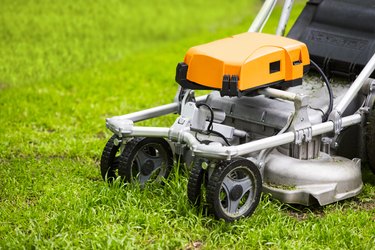
If you want to make mowing the lawn easier, you may want to liberate yourself from your old push-style mower and select a self-propelled model if you haven't already. Instead of requiring you to put forth all the effort to get your mower moving, self-propelled mowers use a set of drive wheels, either front or rear, to propel the mower forward. Front- and rear-wheel propulsion models each offer unique benefits. Before choosing which one is right for you, consider the pros and cons of each.
Self-Propelled Mower Basics
Video of the Day
Unlike push mowers, which require you to provide all the power for the movement of the machine, self-propelled mowers move themselves forward through power supplied to their drive wheels and rely on you only to steer them in the right direction. Self-propelled mowers have a bar on the handle that you must squeeze to engage the blade. When you release the bar, depending on the model of mower, either the blades will stop spinning or the mower's engine will stop. Self-propelled mowers often reach speeds as high as 1 to 3-1/2 miles per hour.
Video of the Day
Front-Wheel Drive
As the name implies, the front wheels on the mower of a front-wheel drive are the ones that propel the mower. The power of the wheels pulls the mower along as they turn. Front-wheel drive mowers are best suited to flat terrain and not yards that contain hills, valleys and steep inclines. Front-wheel drive models easily enable you to easily steer the mower around obstacles like shrubs, trees and lawn ornaments.
Rear-Wheel Drive
The rear-wheel drive mower is the workhorse of self-propelled models. Suitable for terrain with hills, valleys and steep inclines, the rear-wheel drive mower's wheels turn and push the mower ahead no matter what you encounter. While rear-wheel drive models do not provide the maneuverability of front-wheel drive models, they are well suited to large, wide-open spaces. Another drawback: rear-wheel drive mowers are more difficult when it comes to pulling the mower backward for a change in direction since the wheels are always engaged in forward motion.
Self-Propelled Mower Advantages
The most obvious benefit of front- or rear-wheel drive mowers is that almost anyone can mow with them regardless of their strength or fitness level. Self-propelled mowers also make it easier to use a bagging attachment to collect the grass clippings since the clippings collecting in the bag add to the weight of the mower (often by as much as up to 30 pounds), but thanks to the self-propulsion feature, the mower handles the extra weight, rather than the operator.