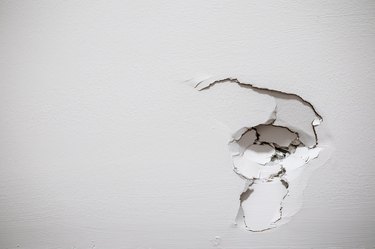
Repairing cracks and holes in plaster walls can be a confusing prospect, given the variety of hole-patching products on the market. The characteristics of the damage to be repaired are the best indicator of the best product for the job.
Here's what wall patching compounds you should consider when your plaster walls need repairing.
Video of the Day
Video of the Day
Plaster Wall Construction
Plaster wall surfaces are constructed from layers of hard plaster that are built up over a wood or metal framework called lath. The plaster itself consists of a mixture of lime or gypsum, an aggregate (typically sand), and water. The plaster is troweled onto the wall surface wet, and when it dries, it forms a very hard, durable surface. Plaster sets quickly and is generally more difficult to work than joint compound or patching compound.
Tip
Modern plaster construction often involves thin coats of plaster applied over special drywall panel, a treatment known as veneer plaster.
What Is Drywall Joint Compound?
Drywall joint compound, commonly called drywall mud, is a gypsum-based paste used to fill and finish seams in drywall construction. It comes in dry power and premixed formulations and is very easy to work with. After drywall contractors install the drywall panels, they cover the seams between the panels with joint tape and cover the tape with two or more layers of joint compound. The gypsum in joint compound makes it a form of plaster, and it's perfectly compatible with traditional plaster, making it a good option for small repairs.
Different joint compound formulations are intended for different jobs, such as taping or finishing, and they vary in their weight, drying times, ease of sanding, and resistance to shrinkage. Many joint compound formulations dry relatively slowly, and you may have to wait several hours or even as much as a day before you can sand or paint over them.
What Is Spackle?
Spackle is a product designed to repair small imperfections in plaster or drywall surfaces. Although the original patching compounds were, like plaster and joint compound, powdered products that needed to be mixed with water, modern patching compounds are typically pre-mixed paste or putty-like products sold in jars and ready to use.
Patching compounds typically dry quickly and remain workable for only a few minutes; they may be sanded and painted in as little as an hour after application. Some patching compounds are made with a gypsum base, and they are vulnerable to shrinking and cracking as they dry. Others are made with a vinyl or acrylic base, which makes them especially flexible and shrink-resistant.
Patching compound is often confused with caulk, which is a flexible substance primarily used to seal gaps and seams, and painter's putty, which is used to fill holes in wood. These products usually are formulated on a base of oil, latex, or synthetic polymers and are not well suited to making repairs in plaster or wall board.
Which Wall Patching Compound for Plaster Repairs?
The best product to use for repairs to plaster walls depends on the extent and nature of the repair. Superficial cosmetic repairs can be made with a basic patching product, but significant structural repairs require a more dramatic solution.
- Minor damage: Nail holes, surface scratches, and shallow gouges can be filled with patching compounds, including repair plaster, spackle, and drywall joint compound. Any of these can be applied in a single layer without reinforcement (such as drywall tape) as long as the patch is not more than 1/8 inch deep. Deeper patches are prone to cracking without reinforcement.
- Medium damage: Slightly larger holes and cracks are better repaired with joint compound and drywall joint tape. This kind of repair is typically more flexible and more resistant than patching compound to the formation of new cracks.This method is effective for cracks and for holes no more than 3 inches in diameter.
- Severe damage: When the damage to a plaster wall extends deeper than the surface layer of plaster, through the base layers or even all the way to the lath, it's likely that neither joint compound nor spackle will be durable enough to make a lasting repair. The best way to repair the damage is to apply multiple layers of plaster, and in the case of large holes, it may be necessary to repair the lath underneath the plaster, too.