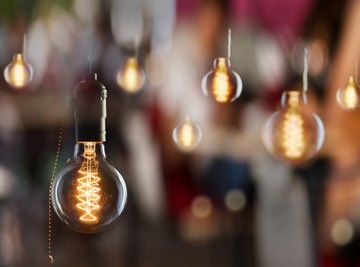
While it's an oversimplification to say that Thomas Edison invented the light bulb, he was one of the first people to create a useful one, and, with modifications, his design has stood the test of time. Although incandescent bulbs of the type Edison developed are still in use today, modern consumers have a few other options. Compact fluorescent (CFL) and light-emitting diode (LED) bulbs are two of the most common. They work on different principles and provide just as much light as incandescents, and they consume less energy.
TL;DR (Too Long; Didn't Read)
The design of incandescent bulbs has changed a little since Edison developed his prototype. Modern improvements include tungsten filaments and inert gases inside the globe. Alternatives such as CFLs and LEDs, although not true bulbs, are more efficient.
What's in a Bulb?
One of Edison's most important innovations was to allow electricity to pass through a thin, highly resistive filament rather than simply arc between two poles, as had been the standard at the time. Edison made his filament from carbonized bamboo, but to prevent it from burning up, he had to enclose it in an air-tight package to keep oxygen out. Edison's bulbs contained a vacuum, but this made them very fragile, so subsequent manufacturers filled the bulbs with inert gases such as:
- argon
- neon
- helium
- nitrogen
The filaments in modern incandescent bulbs are mostly made of tungsten, and the bulbs are generally filled with argon.
Parts of an Incandescent Bulb
At first glance, an incandescent bulb seems simple, but it actually consists of several individual parts that have become standardized.
Screw Base: The familiar threaded base was developed by Edison and is known as the E-base. Today, several sizes exist.
Globe: The glass enclosure is known as the globe. The familiar pear-shaped one is most common because it distributes light better than other shapes. Frosted globes came on the market in 1925 and are still common.
Filament: In 1911, American physicist William D. Coolidge developed the tungsten filament, and General Electric quickly adapted it into their bulbs. It remains the standard bulb filament.
Contact wires: Thin wires extend from the filament to the screw base and the foot contact at the base of the bulb. They complete the electrical circuit when the bulb is screwed in.
Support wires: A pair of thin wires support the filament and prevent it from contacting the globe of the base when electricity is flowing.
Alternatives to Incandescents
One of the main drawbacks of incandescent bulbs is that they convert only a small fraction of incident electricity into light – about 10 percent. Halogen bulbs, which are similar to standard incandescents but are filled with a halogen gas such as bromine, are more efficient. Halogen bulbs use less energy than standard incandescents, but the amount is arguably not small enough to classify them as energy efficient. Especially not when compared to CFLs and LEDs, which came on the market after the U.S. oil crisis of the 1970s. Compared to incandescents, CFLs and LEDs use 75 percent or less of the energy consumed by an incandescent bulb.
When Is a Bulb Not a Bulb?
Neither CFLs nor LEDs require a globe solely to protect a filament, because neither device has a filament. LEDs consist of diodes that glow when electricity passes through them. Nevertheless, manufacturers construct LEDs with more-or-less pear-shaped globes so consumers can use them in the same way as standard incandescents. CFLs produce light by the ionization of an inert gas, but the bulbs contain a small amount of mercury that requires an airtight enclosure, and the tubes are bent into a bulb shape for ease of use. Although they aren't bulbs in the same way that incandescents are, many CFLs and LEDs have the same Edison-style screw bases, and they can be used interchangeably with incandescents.
References
- The Museum of Unnatural Mystery: Who Invented the Lightbulb?
- Department of Energy: How Energy-Efficient Light Bulbs Compare With Traditional Incandescents
- Del Mar Fans & Lighting: The History of the Light Bulb
- Philips Lighting: Halogen Light Bulbs
- Michigan Department of Health and Human Services: CFLs & Mercury
About the Author
Chris Deziel holds a Bachelor's degree in physics and a Master's degree in Humanities, He has taught science, math and English at the university level, both in his native Canada and in Japan. He began writing online in 2010, offering information in scientific, cultural and practical topics. His writing covers science, math and home improvement and design, as well as religion and the oriental healing arts.