Flowers and fruits are two of a plant's parts that humans love most. They decorate plants, sometimes feed humans and animals, and can have pleasant fragrances. However, fruits and flowers function primarily in plant reproduction. The way fruits and flowers work varies somewhat based on the specific plant species, but in all plants, they help with reproduction in some similar ways.
Flower Pollination
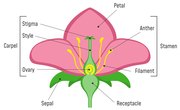
Flowers are where pollination takes place. Flower pollen comes from a plant part called a "stamen" and contains the male reproductive contribution, called "gametes." When pollination occurs, male pollen transfers to female plant structures called "stigma" and "pistils." Some plants have flowers with both pollen and stigma, so that a single flower can pollinate itself. Other plants have flowers with just pistils and flowers with just stamens. Pollen can transfer from one flower to another through the air and on insects, like bees. Brightly colored and fragrant flowers tend to rely on insects rather than wind to pollinate them; they attract insects with their bright colors or fragrance.
Seed Production
When pollination occurs in a flowering plant, the male pollen enters the female ovary containing female ovules. The female plant ovule then matures into a seed. Seed production also creates fruits. Seeds are essential to plant survival because they create new plants.
Fruit Production
Fruits are seed coverings. They are mature plant ovaries that cover mature plant ovules, more commonly called seeds. Some fruits, called "simple" fruits, come from flowers that have only one ovary and, therefore, have a simple round shape with one or more seeds. For example, peaches and tomatoes come from flowers with only one ovary. Other fruits, called "aggregate" fruits, come from flowers that have more than one ovary. These fruits often have a more complex shape than simple fruits, like raspberries and strawberries.
Nuts, although normally considered part of a separate human food group than fruits, are actually fruits with hard shells. Winged maple seeds are also fruits, as are squash and pine cones.
Fruit Function
Fruits protect seeds. They ripen as seeds mature, and then they help disburse seeds rather than protect them. Fruits help plants spread seeds out, because animals transport and discard seeds when they eat fruits. Fruits also fall off trees and start new fruit plants right next to existing plants.
References
About the Author
Lisa Chinn developed her research skills while working at a research university library. She writes for numerous publications, specializing in gardening, home care, wellness, copywriting, style and travel. Chinn also designs marketing materials, holds a Bachelor of Science in psychology and is working toward a PhD in cognitive neuroscience.
Photo Credits
Jupiterimages/Creatas/Getty Images