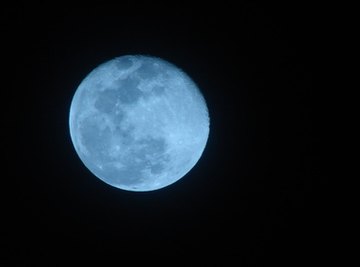
The moon affects the weather in several indirect ways. The moon has a large effect on ocean tides, and tides have a significant effect on the weather in the sense that a world without a moon would experienced little or no tides and would have a different system of weather. The moon also has a small effect on polar temperatures.
Tidal Effect
Since the moon's gravitational force depends on distance, at any given time, the portion of the Earth closest to the moon (i.e., directly underneath it) is most strongly influenced by gravity. This means that when the moon is over an ocean, the water is pulled toward it, creating what is called the tidal bulge. As the moon orbits the Earth, the tidal bulge acts like a wave sweeping around the Earth. This effect causes the tides.
Ocean Tides
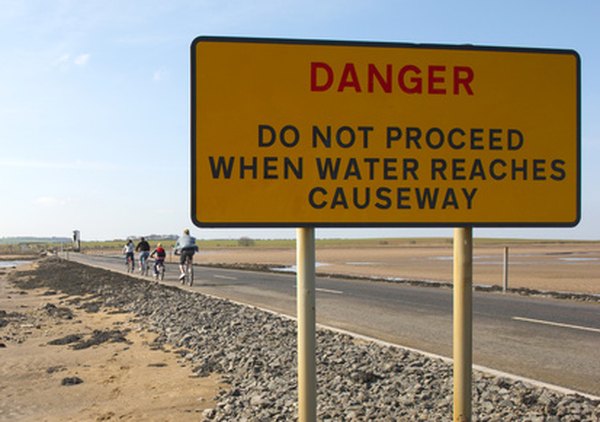
Generally, two low tides and two high tides occur in every 24 hour period, about 50 minutes later each day. During the new moon and full moon, high tides are higher and low tides lower than normal. During the first and last quarter moon, high and low tides are more moderate than normal. Tides affect the movement of ocean currents, which affect the weather through the amount of warming or cooling water moving through a given area. For example, water temperature combines with wind strength and direction to define the duration and strength of weather events like the El Niño.
Atmospheric Tides
The atmosphere is subject to the same tidal forces as the oceans, although to a much lesser extent. Gases are less responsive to tidal forces because they are so much less dense than water. These tides affect atmospheric pressure, a well-known factor in weather systems. However, the increase in atmospheric pressure which can be detected at the front edge of the tidal wave is so small it is thought to be overwhelmed by other factors.
Tidal Effect on Land
Tidal forces also affect solid land, although to much lesser extent than they affect water. New satellites which can measure the Earth's topology confirm that the moon affects the height of the land. Land tides are limited to approximately 1 cm, compared with about 1 meter for ocean tides. Some scientists hypothesize that these tiny shifts might affect volcanic activity and earthquakes.
Polar Temperature
Satellite measurements of the temperature of the atmosphere shows that the poles are 0.55 degrees Celsius (0.99 degrees Fahrenheit) warmer during a full moon than during a new moon. Measurements show no effect on temperatures in the tropics, but the temperature around the globe is on average 0.02 degrees Celsius (0.036 degrees Fahrenheit) higher during the full moon. These small temperature changes have a slight but measurable affect on the weather.
References
About the Author
Nashvillian Elizabeth Merriam has been a professional writer since 2000. Her work has appeared in more than 100 periodicals, including "Visual Arts News" and "Eastword." She holds a Bachelor of Arts in English and mathematics from Dalhousie University in Canada.
Photo Credits
moon image by Stefan Häuselmann from Fotolia.com