
General Sherman Tree Facts

General Sherman Tree Facts thumbnail
This giant sequoia dwarfs the tourist at its base.

The General Sherman Tree is one of the most-visited sequoias in the United States. Although many sequoias met their demise in turn-of-the-century lumber mills, the General Sherman Tree escaped that fate and is now part of Sequoia National Park. Its National Park Service sign names it as "The Largest Living Thing on Earth" which is easy to believe when standing next to its massive girth.

  1. Location

    • Hiking through sequoias is a dizzying experience.
      Hiking through sequoias is a dizzying experience.

      The General Sherman Tree is located in Sequoia National Park, California. The General Sherman trailhead is just off of Generals Highway at Wolverton Road, and the ½-mile trail is paved. Multiple other trails also lead to the General Sherman Tree and handicap accessible parking is located directly off Generals Highway. The General Sherman trail itself descends 200 feet, less than the height of the tree.

    Description

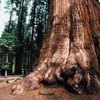
    • Giant sequoias have surprisingly shallow roots.
      Giant sequoias have surprisingly shallow roots.

      The General Sherman Tree is a giant sequoia (Sequoiadendron giganteum). Sequoias only reproduce through seed, and this particular tree started growing 2,000 years ago. Giant sequoias are more cold-hardy than their cousins, the coast redwoods, and the giant sequoias' foliage is bushier. The gray-green scaled leaves are prickly, and they have extensive, shallow root systems that require adequate soil moisture. In harsh weather, the giant sequoia drops branches; in the winter of 2006 the General Sherman Tree dropped a large branch that demolished a section of fencing and damaged the walkway. Mature giant sequoias have bare trunks for much of their length and the General Sherman Tree's first branch begins 130 feet from the ground.

    History

    • John Muir, an early naturalist, explored California's mountains on foot.
      John Muir, an early naturalist, explored California's mountains on foot.

      Sequoia National Park is the second national park, Yellowstone being the first. The first park superintendents were federal military men acting under the War Department. These early captains of Sequoia National Park named many trees after generals and past presidents of the United States, but an early settler named Jim Wolverton christened the General Sherman Tree in 1879. Wolverton served under General Tecumseh Sherman in the Civil War and later moved out west to work with Hale Tharp, the first recorded white settler in the area, according to the Sequoia National History Association. Along with John Muir, the three explored the Giant's Forest area of Sequoia National Park, where the General Sherman Tree is located.

    Size

    • The National Park Service lists the General Sherman Tree as 274.9 feet tall and 102.6 feet in circumference at its widest point. It is not the tallest tree, or the widest, but in sheer volume it is the largest tree in the world. Its trunk consists of 52,500 square feet of wood. When calculating a tree's size, researchers only determine the conical volume of the trunk, and do not include the branches or crown.

    Growth Rate

    • Giant sequoias do not stop growing.
      Giant sequoias do not stop growing.

      The General Sherman Tree is still growing and, according to the California State Park's website, "has added enough wood each year to construct a five or six room house." With this growth rate, the General Sherman Tree will continue to be the world's largest known tree.

Related Searches:

References

  • Photo Credit giant sequoia image by Paul Moore from Fotolia.com Redwoods image by Towards Ithaca from Fotolia.com giant sequoia"s image by pixelcarpenter from Fotolia.com rocks image by Sergey Galushko from Fotolia.com World"s largest tree image by Robert Erickson from Fotolia.com

Comments

You May Also Like

  • Weird Tree Facts

    Trees populate the earth in a variety of forms. This diverse group of plants enrich the lives of people who live amongst...

  • The Largest Trees in California History

    The Largest Trees in California History. With its groves of Giant Sequoias, California boasts some of the largest trees in the world....

  • Where Is the Biggest Tree in the World?

    "Biggest" could be defined several different ways, either by volume, mass, height, or length. But when it comes to trees, two species...

  • Where Is the World's Largest Tree Located?

    The tallest tree in the world is a coast redwood named Hyperion. Located in California's Redwood National Park, this giant was discovered...

  • General Information About Oak Trees

    General Information About Oak Trees. Oak trees are part of the Quercus genus and grow in evergreen and deciduous species). Oak is...

  • Facts About Sequoia Trees

    The sequoia tree originates from coastal California and southwestern Oregon. Also known as the coast redwood and California redwood, it is a...

  • Native Tree Facts

    Native trees consist of species found in the region where they evolved. The trees offer drought, pest and disease resistance, making them...

  • Redwood Forest Facts

    There are three main species of redwood trees, including the coastal redwood, the giant sequoia and the dawn redwood. Learn about coastal...

  • Information on Sequoia National Park

    Below the Yosemite Valley along the inner crook in California's elbow, in the heart of the High Sierra, is the Sequoia National...

  • Dawn Redwood Tree Care

    Dawn redwood (Metasequoia glyptostroboides) is a deciduous conifer known for its majestic tree form and bronze foliage in fall. Scientists thought the...

  • Ligustrum Tree Diseases

    Ligustrum, or privet, is a vigorously growing evergreen with several variations, including the Japanese privet, Chinese privet, California privet and the glossy...

  • The Size of Redwoods

    Native to the West Coast of North America, redwoods are the world's largest trees. The largest of the large occur in the...

  • How to Find Hiking Trails in Sequoia National Park

    In Sequoia National Park, big trees are the reason people visit. The giant sequoias are scattered all along the Sierra Nevada mountains...

  • Coniferous Trees of the Sierras

    Coniferous Trees of the Sierras. The Sierra Nevada mountain range runs for more than 250 miles along the border of California and...

Related Ads

Featured