

Swingline Staple Gun Instructions

Swingline staple guns are used for heavy-duty stapling operations both at home and in business around the world. Staple guns are differentiated from typical desktop staplers in that they use much heavier staples and do not fold the ends of the staple over after the staple has been driven.
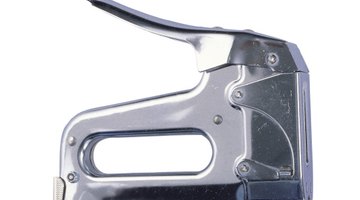
These staple guns are spring-loaded, providing the power necessary to drive the staple into wood, not by the strength of the user but with the spring itself.
-
Load the Swingline staple gun by removing the spring loaded push bar located on the back of the stapler's handle. Slide the staples into the stapler, and then replace the push bar, locking it in place.
-
Press the stapler against the surface that is to be stapled. You will notice that there is a line in the middle of the front of the stapler near where the staple is ejected. This line indicates the center point of the staple and allows you to safely staple around wires.
-
Depress the handle trigger to actuate the stapler. The trigger works by applying downward force to the handle while holding the stapler in place. You will feel the stapler kick slightly and you will hear an audible click sound when the stapler has been set in place.
Warning
Avoid stapling powered electrical lines, as the Swingline stapler is powerful enough to break through the wire shielding, causing a short circuit.
References
- "Tools: A Tool-by-Tool Guide to Choosing and Using 150 Home Essentials"; Steve Dodds; 2005
- "The Homeowner's Ultimate Tool Guide: Choosing the Right Tool for Every Home Improvement Job"; Sandor Nagyszalanczy; 2006
- "Field Guide To Tools: How To Identify And Use Virtually Every Tool At The Hardware Store"; John Kelsey; 2009
Writer Bio
Don Kress began writing professionally in 2006, specializing in automotive technology for various websites. An Automotive Service Excellence (ASE) certified technician since 2003, he has worked as a painter and currently owns his own automotive service business in Georgia. Kress attended the University of Akron, Ohio, earning an associate degree in business management in 2000.
Photo Credits
- Comstock/Comstock/Getty Images
- Comstock/Comstock/Getty Images
More Articles

