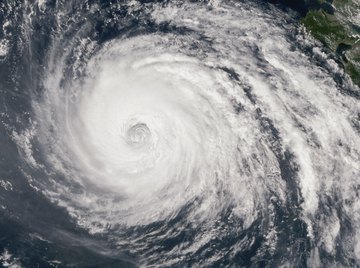

Typhoons can be storms of devastating proportions. With winds gusting between 75 and 200 miles per hour, typhoons are some of the most impressive storms on the planet. The destructive power of typhoons makes early warning and preparation vital, which is why meteorologists work hard to answer two very important questions about typhoons: Where do typhoons occur, and how do they form? The answers to these questions allow scientists to make lifesaving predictions about when and where typhoons will occur.
How and Where Do Typhoons Form?
Typhoons don’t begin their lives as monsters. Instead, they begin as something called a tropical wave. A tropical wave is an atmospheric area of low pressure caused by rising warm air. These regularly form in the tropics, where the sun shines directly for most of the year. Because warm air can hold water better than cool air, low-pressure systems like tropical waves are warmer and wetter than the surrounding air, and they often appear carrying clouds.
The tropical waves that form typhoons tend to originate from a region meteorologists call the monsoon trough, which is part of the Western Pacific's intertropical convergence zone. In this zone prevailing winds push westward from South America toward Asia and Australia.
As the tropical wave moves westward, warm, wet ocean air is added to the wave, increasing its size. If the sea surface under the tropical wave is at least 26.5 degrees Celsius (80 degrees Fahrenheit), it can supercharge the wave with enough heat energy and water to form a typhoon.
What Causes a Typhoon?
Tropical waves don’t automatically give birth to typhoons, though. Other conditions have to be met for the tropical wave to become a full typhoon. First, there has to be a vertical temperature profile in the atmosphere that can cool warm air enough to cause convection. This means that hot air, as it rises, is cooling enough to condense the water vapor it’s holding. As this happens, thunderstorms form.
As the tropical wave travels, it will encounter persistent converging winds in the lower and middle part of a region of the atmosphere called the troposphere, which is between three and six miles from the Earth's surface. These winds are often associated with thunderstorms.
As the tropical waves encounter winds carrying thunderstorms, the heat and water vapor from those storms, along with heat from the ocean’s surface, can intensify the storm’s counterclockwise cyclonic rotation. This is called a mesoscale convective complex, and the collision can produce a rotating column of air called a mesoscale convective vortex. This vortex is the beginning of a cyclone.
The Coriolis Effect
If these forces meet more than 300 miles away from the equator, an additional force comes into play. The Coriolis force, which is caused by the rotation of the Earth, will cause the storm’s rotation to intensify. It also causes the storm to appear to take a path that curves to the right as it moves. In reality, the storm is moving south while the Earth rotates underneath it.
How Does a Typhoon Work?
At this point, the slowly rotating storm is called a tropical depression. As the storm gains energy, it can begin spiraling faster and faster, powered by hot air rising from the ocean’s surface and cool air falling back toward it. Eventually, as it speeds up and reaches 39 miles per hour (63 kilometers per hour), it will be reclassified as a tropical storm. Once rotation reaches speeds of 74 miles per hour (120 kilometers per hour), it becomes a category 1 typhoon.
Are Typhoons and Hurricanes the Same Thing?
A typhoon and a hurricane are the same meteorological phenomenon: tropical cyclones. The only difference between the two is where they occur. A strong tropical cyclone that spawns east of the international date line is called a hurricane. Storms that form to the west of the international date line are classified as typhoons. Other than that, the conditions that lead to the formation of both typhoons and hurricanes are identical.
When Is Typhoon Season?
While hurricanes and typhoons can occur year-round, they tend to peak seasonally. So when is typhoon season? For Pacific typhoons near Australia, the peak of the season is typically February, whereas hurricane season in the Atlantic peaks in September.
This peak corresponds with the transition from summer to winter in each hemisphere, when the temperate waters surrounding the tropics are the warmest. While there is a peak in the occurrence of typhoons, there is no officially recognized typhoon season due to the fact that the peak in typhoon occurrence varies with geography.
References
- National Ocean Service: How Do Hurricanes Form?
- National Hurricane Center and Central Pacific Hurricane Center: Saffir-Simpson Hurricane Wind Scale
- Hurricanes: Science and Society: Hurricane Genesis: Birth of a Hurricane
- National Geographic: The Coriolis Effect
- Meteo France: Climatology
- National Ocean Service: What is the Difference Between a Hurricane and a Typhoon?
About the Author
Cameron is a writer and educator based out of Fort Collins, Colorado. His work has appeared in New Scientist, LiveScience, Discovery's Curiosity Daily podcast, and MinuteEarth. He teaches Ecology and Evolution at the University of Northern Colorado.
Photo Credits
Purestock/Purestock/Getty Images