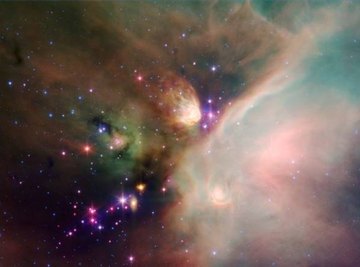

Detecting neutron stars requires instruments that are different than those used to detect normal stars, and they eluded astronomers for many years because of their peculiar characteristics. A neutron star is technically no longer at a star at all; it is the phase that some stars reach at the end of their existence. A normal star burns through its hydrogen fuel over the course of its life until the hydrogen is burned up and the forces of gravity cause the star to contract, forcing it inward until the helium gases go through the same nuclear fusion that the hydrogen did, and the star erupts into a red giant, a last flare before its final collapse. If the star is large, it will create a supernova of expanding material, burning up all its reserves in one spectacular finale. Smaller stars are broken apart into dust clouds, but if the star is large enough its gravity will force all of its remaining material together under enormous pressure. Too much gravitational force, and the star implodes, becoming a black hole, but with the right amount of gravity the star's remains will fuse together instead, forming a shell of incredibly dense neutrons. These neutron stars rarely give out any light and are only several miles or so across, making them hard to see and difficult to detect.
Neutron stars have two primary characteristics that scientists can detect. The first is a neutron star's intense gravitational force. They can sometimes be detected by how their gravity affects more visible objects around them. By carefully plotting out the interactions of gravity between objects in space, astronomers can pinpoint the place where a neutron star or similar phenomenon is located. The second method is through the detection of pulsars. Pulsars are neutron stars that spin, usually very fast, as a result of the gravitational pressure that created them. Their enormous gravity and fast rotation cause them to stream out electromagnetic energy from both their magnetic poles. These poles spin along with the neutron star, and if they are facing Earth, they can be picked up as radio waves. The effect is that of extremely rapid radio wave pulses as the two poles turn one after the other to face the Earth while the neutron star spins.
Other neutron stars produce X radiation when the materials within them compress and heat until the star shoots out X-rays from its poles. By looking for X-ray pulses, scientists can find these X-ray pulsars as well and add them to the list of known neutron stars.
References
About the Author
Tyler Lacoma has worked as a writer and editor for several years after graduating from George Fox University with a degree in business management and writing/literature. He works on business and technology topics for clients such as Obsessable, EBSCO, Drop.io, The TAC Group, Anaxos, Dynamic Page Solutions and others, specializing in ecology, marketing and modern trends.
Photo Credits
Formation of Stars