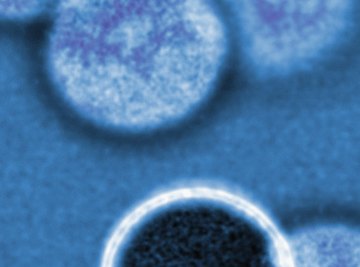

Cells, and the larger organisms that they comprise (except in the case of unicellular organisms), require proteins for numerous functions. It is the responsibility of the ribonucleic acid (RNA) to facilitate the synthesis of these proteins from the genetic material (DNA).
To carry out this process, there are three types of RNA: messenger RNA, ribosomal RNA and transfer RNA. It is the transfer RNA, also called tRNA, that is responsible for delivering the correct amino acids to the translation site.
Amino acids are carried to the ribosomes by units of tRNA.
The Three Types of RNA
Messenger RNA (mRNA) functions as the blueprint for protein synthesis, and directs the process. Ribosomal RNA (rRNA) functions as the factory, providing the structure for the synthesis process and performing the bonding work.
Transfer RNA (tRNA) functions as the delivery vehicle, collecting and dropping off the correct amino acids to the factory, or translation site.
Messenger RNA
The cell’s deoxyribonucleic acid (DNA) contains all the genetic material of the cell comprised of segments called genes. Each DNA gene contains the instructions for producing a specific protein.
Messenger RNA is essentially a copy of one section, or gene, of DNA. An enzyme called RNA polymerase reads the DNA code and creates a strand of mRNA. This transcribes a "message" (hence the name messenger RNA) that is used in order to eventually create a protein based off of the DNA information.
This mRNA strand is made up of triplets of nucleotides that are called codons. Each of these codons represents one amino acid.
Ribosomal RNA
Ribosomal RNA (rRNA) binds with a protein to form a ribosome. The ribosome serves as the stabilizing structure during the protein syntheses process. It essentially is the site of protein synthesis, almost like a protein factory.
The rRNA also carries the enzymes required to bond the amino acids together. The rRNA attaches to the strand of mRNA, moving along like a zipper as it binds the amino acids together. Multiple mRNAs can be attached and working simultaneously at different points along the mRNA strand.
Transfer RNA
There is at least one tRNA for each type of amino acid. The tRNA is relatively small and resembles the configuration of a clover leaf. Each tRNA has a nucleotide triplet, called an anticodon. This anticodon is the opposite match for one codon on the mRNA.
The tRNA also carries the corresponding amino acid for its anticodon. The tRNA brings amino acids to the ribosome (rRNA). The amino acid is then "dropped off" and is fused with the growing chain of amino acids based off of the mRNA sequence. This ultimately creates the protein coded for by the DNA.
The Protein Synthesis Process
The mRNA is produced in the nucleus of the cell. When the cell determines that the given mRNA’s protein is needed, the mRNA is moved out of the nucleus and into the cell’s cytoplasm. The mRNA meets up with a ribosome, where they attach together to form the site of the protein synthesis.
The tRNA move about the cytoplasm picking up the amino acid that corresponds to their anticodon and transports it to the ribosome. The tRNA reads the mRNA, attempting to find a corresponding match between their specific anticodons and the next codon on the mRNA. When a match is made, the matching tRNA releases its amino acid to the rRNA.
The rRNA then bonds the amino acid, representing the next link in the protein sequence, to the growing string of amino acids. Once the entire sequence of amino acids has been assembled, the protein is "folded" into its proper configuration.
With that, the protein synthesis is complete.
References
About the Author
Doug Bennett has been researching and writing nonfiction works for more than 20 years. His books have been distributed worldwide and his articles have been featured in numerous websites, newspapers and regional publications. Bennett's background includes experience in law enforcement, the military, sound reinforcement and vehicle repair/maintenance.
Photo Credits
Chad Baker/Photodisc/Getty Images