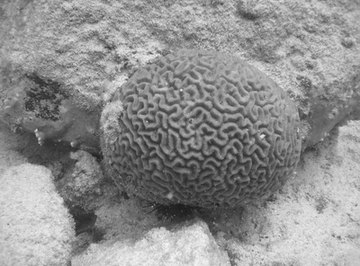
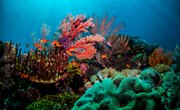
Despite their name, brain corals are completely brainless and are not as intelligent as their name implies. Their spherical shape and grooved surface of a sea brain resembles an underwater brain, but the animals within the stony exterior are simple invertebrates related to jellyfish and sea anemones. Although their anatomy is simple, these animals and their architectural abilities play a starring role in complex coral reef communities.
Structure and Growth
There are two main types of corals: hard and soft. Brain corals belong to a group of hard corals, or stony corals. Their structure is made of calcium carbonate, or limestone, which hardens into a rock-like exoskeleton. These skeletal structures become cemented together to form a sphere that gives brain corals their shape. Brain corals grow very slowly as each generation adds to the limestone skeleton. Some brain corals can live up to 900 years. Because of their massive, sturdy structure, they form the foundation of coral reefs and can grow to 6 feet tall.
Living Brain Coral
Corals are part of the phylum Cnidaria and are related to anemones and jellyfish. Brain corals – like all the animals in this group – are invertebrates, meaning they have no backbone. Although they look like rocks, brain corals are animals. The living parts of the coral are called polyps. A polyp’s body is a soft, fleshy tube with tentacles that surround its mouth. Polyps excrete the calcium carbonate that make up the hard, nonliving part of coral. After the polyps die, their limestone skeleton remains, and each generation of polyps adds to the structure.
Where They Live
Brain corals live in the Caribbean Sea and Atlantic and Pacific Oceans. Most corals reefs grow in tropical or subtropical water, between 30 degrees N latitude and 30 degrees S latitude. Reef-building corals like brain corals can’t live in water cooler than 18 degrees C, or about 64 degrees F. Brain corals prefer clear, shallow water that allows sunlight to penetrate.
How They Eat
The polyps of brain corals are sessile, meaning they stay in one place all the time. They obtain food by eating tiny organisms called zooplankton that float past them. Individual polyps look like tiny anemones. Like their cnidarian cousins, coral polyps have stinging cells on their tentacles. They use the tentacles to direct micro-organisms into their mouths. Some of the brain corals' diet comes from the food produced by algae that live among them.
Working Together
Brain corals belong to a community of organisms that make up a coral reef. Symbiosis plays a big part in coral reef communities as organisms benefit from each other to help the community succeed. Among the brain coral’s closest friends and associates are zooxanthellae. These tiny, photosynthetic algae live on and within the coral structure and share the food they produce with the coral polyps. The algae also provide the coral polyps with oxygen. The algae gain protection by living on the coral and are better exposed to sunlight, which they need for photosynthesis.
Fluorescent Corals
Another group of brain corals have a folded, rather than spherical shape and live free-standing instead of part of the structure of a larger reef. These species are called open brain corals. Some species of have a fluorescent protein that allows them to emit vibrant colors when exposed to UV, violet or blue light. Members of the genus Trachyphyllia and the genus Lobophyllia are two examples of corals that have this protein. These corals are more colorful than other types of hard corals and are popular specimens in saltwater aquariums.
References
About the Author
A.P. Mentzer graduated from Rutgers University with degrees in Anthropology and Biological Sciences. She worked as a researcher and analyst in the biotech industry and a science editor for an educational publishing company prior to her career as a freelance writer and editor. Alissa enjoys writing about life science and medical topics, as well as science activities for children
Photo Credits
brain coral black and white image by Paul Retherford from Fotolia.com