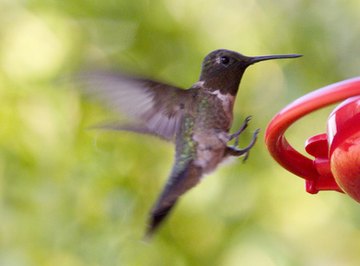
With their small size and high metabolism, the hummingbird lifespan is generally only a few years, but the life expectancy of a hummingbird is variable and some have survived for more than a decade. The oldest known wild hummingbird lived to 12 years and 2 months. In captive environments such as zoos, with proper feeding and nutrition, hummingbirds can live up to 14 years. In the wild, they spend their lives in a fast-paced migratory search for food.
Hummingbird Fundamentals
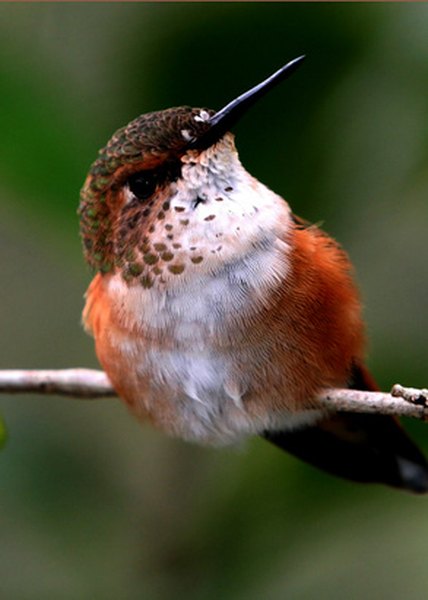
The hummingbird is a small bird of the Trochilidae family. The rapid beating of the hummingbird's wings (60 to 80 beats per second) makes the distinctive humming sound from which they get their name, according to How to Enjoy Hummingbirds. The hummingbird heart rate and breathing rate is also very rapid, to support its rapid wing movement.
Hummingbirds weigh between 2 and 20 g, have long narrow bills and small knife-shaped wings, according to the National Zoo’s Migratory Bird Center. Males and some females abound with color on highly reflective feathers on the throat and upper chest.
While there is limited data to work with, ornithologists think most hummingbirds die within a year of being hatched. Those that do survive live an average of 3 to 4 more years, according to Hummingbirds.net.
Age Studies
The oldest known hummingbird was a female broad-tailed hummingbird that scientists banded in 1976 in Colorado. She was recaptured in the same place in 1987 at the age of 12 years and 2 months. Scientists assume she died after that, since she was not found again.
The oldest known ruby-throated hummingbird was 6 years, 11 months old, according to How to Enjoy Hummingbirds. Scientists are able to determine or estimate age by tracking birds that have been banded.
Banding studies in Arizona determined that a female black-chinned hummingbird was at least 10 years old when last found, making it the oldest known hummingbird in the state, according to the Southeastern Arizona Bird Observatory.
Major Features
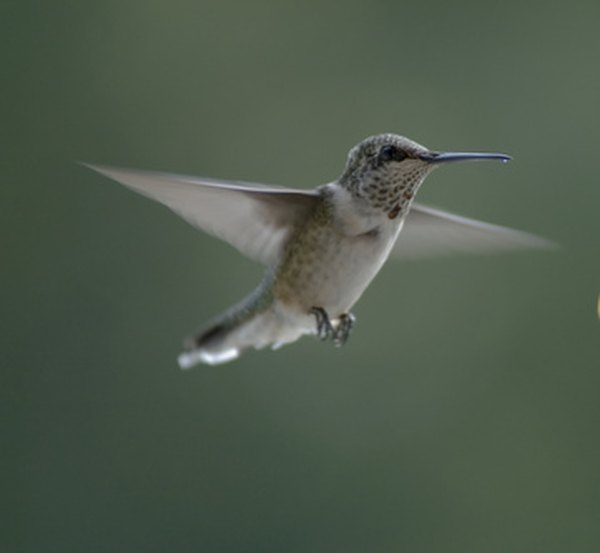
Hummingbirds survive by drinking nectar, the sweet liquid inside flowers. During breeding season and when they’re feeding chicks, hummingbirds also consume insects and spiders to get the protein and other minerals that nectar alone does not provide, according to the National Zoo’s Migratory Bird Center.
The diet composed mostly of high-sugar nectar supports the bird’s high metabolism that keeps its wings beating at fast speeds as it flits from flower to flower or migrates long distances. A ruby-throated hummingbird’s heart beats more than 1,200 times per minute when it is flying and 225 times per minute when at rest, according to the National Zoo’s Migratory Bird Center. The bird’s wings flap 70 times per second in flight with bursts of more than 200 times per second while diving.
Unlike most other birds, hummingbirds can fly upward, downward, forward, backward and sideways, as well as hovering, according to Wild Birds Unlimited.
Types of Hummingbirds
The known 340 species of hummingbirds live almost exclusively in the Western hemisphere and can be found from Tierra del Fuego in southern Chile to southern Alaska at elevations from below sea level to more than 16,000 feet, according to the National Zoo’s Migratory Bird Center.
Seventeen species nest in the United States, most of them close to the Mexican border. Only the ruby-throated hummingbird nests east of the Mississippi River.
Migration Patterns
Hummingbirds’ nectar-dependent diet means they travel long distances to find flowers in bloom. The ruby-throated hummingbird migrates about 600 miles across the Gulf of Mexico twice each year. They can fly 18 to 20 hours without rest, according to the Migratory Bird Center at the National Zoo in Washington, D.C.
Hummingbirds in the western United States migrate north through lower elevations in the spring and return south through mountain areas in summer to take advantage of later-blooming flowering plants, according to the Migratory Bird Center.
References
Resources
About the Author
Jan Day’s career as a writer and editor started in 1978 in Tennessee and continued through her work with major news organizations, including "The Denver Post" and Bloomberg News. She now focuses on travel, fitness, wine and food writing. She holds a Master of Arts in journalism from Pennsylvania State University.
Photo Credits
hummingbird image by cherie from Fotolia.com