Definition of Weather Forecaster

Definition of Weather Forecaster thumbnail
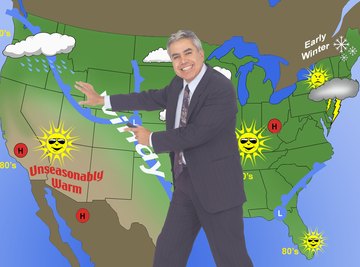
Weather forecasters use weather data from around the world to make predictions at home.

People depend on weather forecasters to help them see into the future to plan birthday parties, trips to the beach, gardening and weddings. Weather forecasters provide crucial information about the weather to come, and in severe weather systems forecasters announce short-term forecasts and warnings to help save lives. Weather forecasters depend on accurate meteorological observations, calculations and computer models to predict approaching storms and other systems every day.

  1. Definition

    • A forecaster bases predictions off atmospheric calculations.
      A forecaster bases predictions off atmospheric calculations.

      A weather forecaster, also called a weatherman or weatherperson, is a person who uses meteorological data to forecast, or predict, the weather. This forecaster can also report weather conditions on television or radio, or choose a team of forecasters.

    Early Forecasting History

    • Ancient Babylonians predicted weather through optical illusions, like halos.
      Ancient Babylonians predicted weather through optical illusions, like halos.

      Weather forecasting began when early civilizations used reoccurring astronomical and meteorological events to help monitor seasonal weather changes. According to NASA's Earth Observatory feature article on weather forecasting history, around 650 B.C. the Babylonians attempted to predict short-term weather fluctuations. They based their predictions on the appearance of clouds and optical phenomena, like halos, lighted circles around trees and other objects.

      By 300 B.C., Chinese astronomers developed a calendar that divided the year into 24 festivals where each festival correlated with a distinct weather pattern.

    Early Forecasters

    • Around 340 B.C., Greek philosopher Aristotle wrote Meteorologica, a philosophical treatise where he theorized about the formation of rain, clouds, hail, wind, thunder, lightning and hurricanes.

      According to NASA meteorological research, Aristotle made some remarkably acute observations concerning the weather along with some significant errors. His four-volume text, now available online, was considered as the authority on weather for almost 2,000 years. In the 17th century scientists overthrew most of his ideas with the origin of science-based weather calculations and observations.

    Forecasting Inventions

    • Barometers, invented around 1643, measure atmospheric pressure.
      Barometers, invented around 1643, measure atmospheric pressure.

      In western civilization, the first known forecasting instrument was the hygrometer, an instrument to measure the humidity of air as described by Nicholas Cusa, a German living in the mid 15th century. The Italian Galileo Galilei (1564 to 1642) invented an early thermometer around 1592 and, about 100 years later in 1643, the Italian Evangelista Torricelli invented the barometer for measuring atmospheric pressure.

    Modern Forecasting Tools

    • A weather balloon carries an instrument called a radiosonde to measure atmospheric pressure, temperature and humidity at high altitudes.
      A weather balloon carries an instrument called a radiosonde to measure atmospheric pressure, temperature and humidity at high altitudes.

      As of 2010, forecasters use an assortment of tools to gauge and predict weather systems. Some of these instruments include thermometers to measure temperature, barometers to measure air pressure, rain gauges to measure precipitation and anemometers to measure wind speed.

      Other complex forecasting tools include a radiosonde, attached to a weather balloon, which measures weather high in the atmosphere; satellites orbiting Earth, taking pictures of clouds from space, that show where and how fast clouds are moving; and radars to shoot radio signals into clouds to show where precipitation is falling and how much. A forecaster's sharp eyes and ears, however, also help immensely.

    How Forecasters Work

    • Meteorologists relay their observation and measurements to other meteorologists to mark how weather changes place to place.
      Meteorologists relay their observation and measurements to other meteorologists to mark how weather changes place to place.

      Weather forecasters begin by making observations of what the weather is doing across the globe. Forecasters feed these global observations into super computers that use mathematical models of the atmosphere to make predictions.

      Forecasters use the observations from ground and space, along with formulas and rules based on experience of what has happened in the past, and then make their forecast. Meteorologists generally plot their observations on a weather map every hour to see how fast the weather is changing, and forecast where those changes will occur next.

    Types of Weather Forecasting

    • The method a forecaster chooses depends upon his experience, the amount of information available to him, the level of difficulty the forecast situation presents and the degree of accuracy or confidence needed in the forecast.

      Persistence forecasting assumes that the conditions at the time of the forecast will not change. For example, if it is cloudy and 75 degrees today, the persistence method predicts that it will be cloudy and 75 degrees tomorrow. This forecasting proves accurate where weather patterns change very little, like a southern California summer climate. Synoptic forecasting uses basic rules that the atmosphere follows. Meteorologists take their observations and apply those rules to make a short-term forecast.

      Statistical forecasting works when forecasters ask themselves the question: what does the weather usually do this time of year? Average temperatures, rainfall and snowfall over the years provide forecasters with a strong idea of what the weather should be like at a certain time of year.

      Computer forecasting involves forecasters taking their observations and inserting their numbers into complicated equations. Several ultra-high-speed computers run these various equations to make computer models. These models present a forecast for the next few days. Because equations often produce scattered results, forecasters always use the other forecasting methods alongside computer models. As of 2010, machines cannot forecast alone: meteorology still needs human work and thought to accurately predict the weather.

Related Searches:

References

Resources

  • Photo Credit Rainbows image by pioregur from Fotolia.com weather coast image by Paul Moore from Fotolia.com the suns halo image by Jesse-lee Lang from Fotolia.com old barometer image by Tomasz Nowicki from Fotolia.com balloon image by Francois du Plessis from Fotolia.com instruments on the weather station. image by Tom Oliveira from Fotolia.com

Comments

You May Also Like

Related Ads

Featured