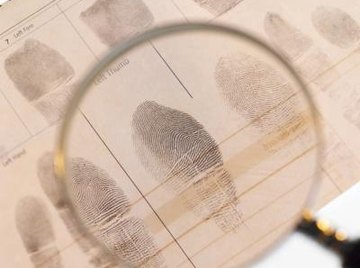

DNA fingerprinting can determine a child's father or identify suspects from crime scene samples. Because 99.9 percent of human DNA is identical, it is the variations in DNA that are analyzed.
History
Dr. Alec Jeffreys at the University of Leicester discovered DNA fingerprinting in 1985 when he saw that DNA samples had different “bar codes” when the DNA was separated on a gel.
First Case
In the 1980s in Britain, DNA fingerprinting was used in an immigration case to show that a boy who was facing deportation was the son of an English woman.
How DNA Fingerprinting Works
Short pieces of variable DNA are copied many times through a polymerase chain reaction, then separated on a gel to see the “bar code.” Except for identical twins, it is very unlikely that two people will have the same DNA pattern.
What is DNA Fingerprinting Used For?
DNA samples have identified criminals, victims and children’s parents. DNA fingerprinting also has proven the innocence of many suspects.
Problems with DNA Fingerprinting
DNA fingerprinting can be inaccurate because of sample contamination or laboratory error. In one case, DNA indicated that a woman was not the mother of her children until other evidence showed she was a chimera: She had different DNA in different cells.
Famous Case
Anna Anderson claimed to be Russia's Grand Duchess Anastasia from the 1920s until her death in 1984. DNA fingerprinting showed that her DNA did not match the patterns of living relatives of the Romanov royal family.
References
About the Author
Roxann Schroeder, Ph.D, has been a science writer and editor for over 10 years. Her experience includes research articles, grants, theses, dissertations, web sites, text books and book chapters. She also teaches biology and grant writing at the local university.
Photo Credits
Stockbyte/Stockbyte/Getty Images