

You've probably heard from your teacher about the simple machines that make up more complicated devices. Two of those machines, the inclined plane and the wedge, are similar even if the wedge moves to do its work and the inclined plane doesn't. Think of an inclined plane as a flat surface tilted upward, so that from the side it looks like a triangle; put two of those triangles together, base to base, and you've got a wedge.
Advantage of Machines
All machines, wedges and planes included, offer something called "mechanical advantage." That means if you apply a force to the wedge or plane, that machine will send out a bigger force somewhere else. Apply your force to the fat end of the wedge, and the thinner, opposite end -- the blade of a knife, say, or the sharp face of the chisel -- multiplies that force. Just as the wedge splits an object, the plane "splits" the force of gravity, some of it perpendicular to the plane's surface, some parallel to it, making it easier to push an object uphill than lift it outright.
Wedge Gives Edge

The wedge is a moving inclined plane if you think of the plane as standing on its narrow end. A force applied at the opposite, wider, end has to go somewhere -- including the narrow end, which applies the force to a smaller area. Same force, smaller area, delivers a punch to whatever happens to be against the narrow end of the wedge: marble that Michelangelo is carving with a chisel, a log that Abe Lincoln's splitting with an ax, or that snowbank you're digging into with a shovel.
Meanwhile, from the perspective of the marble, log or snow, they're being shoved upward along the inclined plane of the face of the chisel, ax or shovel. Much easier than Michelangelo lifting "David," Lincoln hefting the log or you picking up a snowbank and waiting for the parts you don't want to drop off on their own.
Rolling With Inclined Plane

Just as the force you apply to a wedge acts along a distance -- from wide end to thin one -- the force you use to move objects along an inclined plane acts along a distance, too. In the case of the inclined plane, you start at the thin end of the wedge, so to speak, and move up the plane to the wide end. Just as the most useful wedges are long and tapered, the better to deliver a big punch with small effort, the most useful inclined planes slope upward gradually; the longer the distance, the less the force you'll need to roll, push or pull the object along the plane.
You are gradually overcoming the object's resistance, its weight, by applying a force through a distance, just as the wedge overcomes the object's resistance, to being split, by exerting a force onto the narrow business end of the wedge.
Togetherness
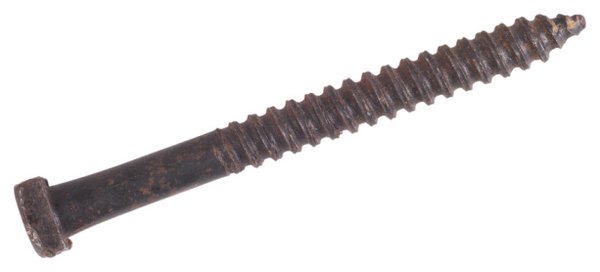
If a wedge works like an inclined plane, and an inclined plane is similar to a wedge, the two simple machines may work even better when put together. That wedge-plane combination is seen in the common household wood screw. The threads are the inclined plane, moving the screw into the wood with less force than you'd need to hammer in the screw. The tip is the wedge, pushing the wood apart.
A zipper is a combination of wedges and inclined planes, to connect and disconnect teeth. Such combinations of the so-called simple machines are common. Science speaks of "families" of machines, different devices working on similar principles -- inclined plane, wedge and screw are in the plane family; three other so-called simple machines, lever, wheel and axle, and pulley, are part of the lever family.
References
About the Author
T.C. Edere is a writer for online publications. Previously, he wrote headlines for newspapers such as "The Plain Dealer" of Cleveland, Ohio, "The Record" of Hackensack, N.J., "New York Post" and "New York Daily News."
Photo Credits
Hemera Technologies/AbleStock.com/Getty Images