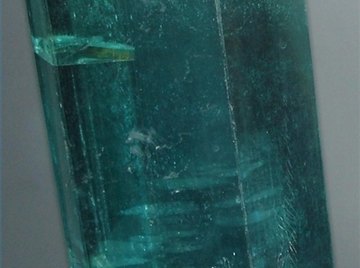

Emeralds are a green to greenish-blue variety of the gem species beryl [Be3Al2 (Si6O18)]. Its color can come from minute amounts of either chromium or vanadium. They are a hard but brittle gem, as flaws are common in their formation. Emeralds form both naturally and through manmade conditions. Manmade emeralds are sometimes called "created" emeralds. Emerald deposits are found in North Carolina and California in the U.S. as well as Columbia, Brazil, Algeria and the Ural Mountains. Common varieties of emerald include the star emerald, Columbian emerald, Zambian emerald, cat's eye emerald, Trapiche emerald and the Brazilian emerald. Common minerals that form next to emeralds are quartz, feldspar and calcite.
Natural Formation
Natural emeralds form in either pegmatite deposits or hydrothermal veins in metamorphic environments. In a hydrothermal vein, hydrothermal fluids have escaped from magma deeper in the Earth's crust. When these fluids contain the specific elements that are in emeralds (like beryllium) and begin to cool in deposit veins, emeralds start to form.
In pegmatite deposits magma, instead of hydrothermal fluids is the key component in emeralds formation. When the magma cools elements remain in the solution of the fluid left over. When the right elements remain, and optimal conditions such as cooling are in place, emeralds form.
In these environments temperatures range approximately 750 to 930 degrees Fahrenheit under pressures amounting to one to three kilobars (about 7.5 to 21.75 tons of pressure per square inch). Cooling takes long periods of time: natural emeralds today formed hundreds of millions of years ago.
Synthetic Formation
There are two main types of synthetic emerald formation environments, hydrothermal and flux-growth. The hydrothermal method involves growing a veneer of emerald over a beryl in an acidic environment and a silicon rich "nutrient." The chemicals are heated approximately 930 to 1112 degrees Fahrenheit at pressures of 700 to 1400 kilobars (5076 to 10150 tons of pressure per square inch). The acidic environment keeps the chromium from separating out of the growing medium and the silicon rich nutrient is kept from the other chemicals to keep from stunting the emeralds' growth.
Flux-growth emeralds involve growing a synthetic emerald over a colorless "seed crystal" beryl. Molybdates, tungstates and vanadates are used to form a "flux." These materials are melted. A beryl is rotated and is placed in contact with a "rotating melt zone," and then removed. This synthesizes the beryl. Wispy feather-like inclusions form often in this growing method.
About the Author
Joan Reinbold is a writer, author of six books, blogs and makes videos. She has been a tutor for students, library assistant, certified dental assistant and business owner. She has lived (and gardened) on three continents, learning home renovation in the process. She received her Bachelor of Arts in 2006.
Photo Credits
Jorfer