Central Tennessee is home not just to the state capital of Nashville, but also rich wetland, forest and grassland habitat for nearly 30 species of native Southeastern snakes. Though snakes tend to shy away from humans, urbanization and agricultural development can bring the reptiles into more frequent contact with people. Most snakes you'll run into in the region are harmless, but it's worth being aware of the handful of venomous species found here.
The Venomous Squad
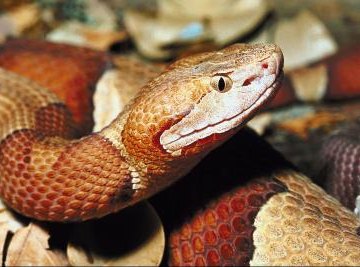
Central Tennessee includes four venomous snakes: the northern copperhead, western cottonmouth (or water moccasin), timber rattlesnake and western pigmy rattlesnake, all of which can be distinguished from non-venomous species by their triangular heads and vertical pupils. All four are so-called pit vipers, named for the heat-detecting pits in front of their eyes. The copperhead and timber rattler are widely distributed in the state; the western pigmy rattlesnake is confined to the Tennessee River floodplain and the cottonmouth – named for its distinctive white mouth, flared defensively – is more common in West Tennessee. Copperheads are the least venomous of the three species, but account for most cases of venomous snakebites in Tennessee. Their namesake tail rattles, meanwhile, give away timber and western pigmy rattlesnakes.
Subterranean Serpents: Earth Snakes
In Tennessee, two earth snake species are found in the middle of the state: the rough earth snake and western smooth earth snake. The major difference between the two species is their scales: Rough earth snakes have keeled, or ridged, scales, while western smooth earth snakes sport smooth scales. Earth snakes are among the smallest snake species in Tennessee, reaching only 10 to 15 inches long as adults. They're called "earth" snakes for their habit of spending much of their time underground and beneath forest litter.
Helpful Hunters: Rat Snakes
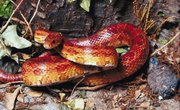
Two kinds of rat snakes are found throughout Central Tennessee: the gray rat snake and red corn snake. As their names indicate, the gray rat snake has gray skin with brown blotches while the red corn snake has a red base of scales with copper ring patterns. Large and handsome serpents, rat snakes may be identified by their round eye pupils and lack of facial pits. Rats and other small rodents serve as their main food item. Tennessee's rat snakes are generalists, living in a variety of environments – from river bottoms to upland forests. Gray rat and red corn snakes are also commonly found near urban homes.
Southeastern Crowned Snake
The southeastern crowned snake is found throughout the southeastern United States, including central Tennessee. This snake gets its name from the black spots on its head; the remainder of the snake's body is a tan color. As adults, southeastern crowned snakes may grow up to 1 foot. Woodlands and hilly grasslands are the primary habitats of the southeastern crowned snake, which, like the earth snakes, is mostly a "fossorial" (burrowing) creature.
Common Garter Snake
One of the most common snake species in Central Tennessee – and the United States – is the common garter snake. Common garter snakes live up to their name, abundant as they are in a wide variety of habitats; they're also frequently found in gardens. These snakes are also known for living and hibernating in large groups.
References
- Tennessee Herpetological Society: Snakes of Tennessee - Venomous or Not?; Lisa Powers
- Savannah River Ecology Laboratory: Smooth Earth Snake
- Savannah River Ecology Labratory: Rat Snake
- Tennessee Herpetological Society: Common Garter Snake
- Tennessee Herpetological Society: Amphibian & Reptile Checklist for Middle Tennessee
Resources
About the Author
Skip Davis has been writing professionally since 2005. His work has appeared in "Southern Literary Magazine," on various websites and in graphic panels at the Jackson Zoological Park in Jackson, Miss. Currently living in Southern California, Davis received his Bachelor of Arts in theater at Belhaven College.
Photo Credits
Jupiterimages/Photos.com/Getty Images