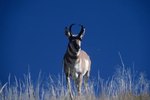

North America is home to two species of deer, the white-tailed deer and the mule deer. While the white-tailed deer inhabits most of the contiguous United States, the mule deer inhabits less of it. In some states, it's important to know the difference in the two species, especially if you are hunting them.
Antlers
Buck, or male, white-tailed deer and mule deer have antlers. White-tailed bucks' antlers consist of a main beam with tines growing out from that beam. Mule deer bucks' antlers fork from the beam and then fork again. The result gives a very different look.
Ears
Both white-tailed deer and mule deer have large ears to allow them to hear predators as they approach. However, mule deer ears are larger and tend to be set at about a 30 degree angle on the head, versus the white-tailed deer ears, which stand more erect.
Tails
White-tailed deer have brown tails with white fringe. When alarmed, they raise their tails, revealing all-white undersides. Mule deer have white, ropy tails with black tips. They do not raise in alarm.
Size
White-tailed deer and mule deer are about the same size. They can weigh between 80 and 400 pounds, depending on sex, age and geographic location. Both stand between 3 to 3 1/2 feet tall at the shoulder.
Coat colors
Both species are reddish-brown in the summer time. In the wintertime, their coats change to gray.
Geographic Distribution
Mule deer inhabit western North America from northwest Canada all the way south into central Mexico. White-tailed deer inhabit all of the United States except for three Western states. The white-tailed live in most of southern Canada, all of Mexico, all of Central America to Bolivia in the south.
Reproduction
White-tailed deer and mule deer have slightly different reproduction and mating cycles. Mule deer mate from mid- to late November; white-tailed deer breed from late November to early December. Gestation for mule deer is seven months, for white-tailed deer 6 1/2 months. White-tailed deer does, or females, can breed at 6 months of age. Mule deer does must be older before they can breed.
Movement
Mule deer have stiff-legged, bounding hops that other deer do not have. They use this hop to escape predators. White-tailed deer gallop rather than hop.
References
- Northern State University: White-Tailed Deer and Mule Deer
- Montana Fish, Wildlife and Parks: 2012/2013 Hunting Regulations: Deer, Elk, Antelope: Antelope, Deer, Elk, Bear, and Wolf Identification Guides
- Ferris State University: Mule Deer - Odocoileus hemionus
- University of Michigan Museum of Zoology Animal Diversity Web; Odocoileus virginianus, White-Tailed Deer; Tanya Dewey
- Idaho Museum of Natural History: Odocoileus hemionus - Mule Deer
Photo Credits
-
Jupiterimages/Photos.com/Getty Images