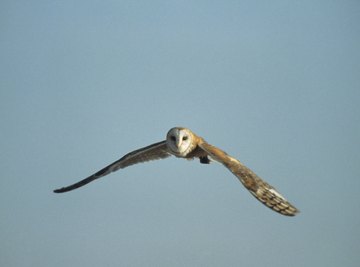

The northeastern United States is home to seven types of owls. The populations of eastern screech-owls, great horned owls, barred owls and northern saw-whet owls are stable and even increasing. The common barn owl, long-eared owl and short-eared owl populations are in decline. Reasons for decline in owl populations include vanishing habitat, development and increased use of rodent poisons, which make their way up the food chain to owls.
Common Barn Owl
The common barn owl (Tyto alba) is one of the most common owls around the world and in the northeast. Many barn owls migrate to the southeast during winter, but others are year-round residents. Barn owls are white on the underside of their bodies and have white faces. The head and back are brown. The largest barn owls weigh only about a pound and a half. Roosting in quiet places like barns during the day, these owls hunt for prey in open fields and meadows at night.
Eastern Screech-Owl
The eastern screech-owl (Megascops asio) ranges across all of the eastern United States. It does not migrate and begins courting in late winter and early spring. The screech owl has noticeable ear tufts and yellow eyes. Its body coloring ranges from gray to brown. The largest screech owls weigh about a half-pound. The screech owl will make its home in various habitats, including wooded subdivisions.
Great Horned Owl
The great horned owl (Bubo virginianus) is the largest and most ferocious predator among the northeastern owls. Weighing more than three pounds, great horned owls are found throughout much of the United States. They prey upon rodents, fish and insects. Their most notable feature is their large ear tufts. Their coloring ranges from shades of brown to black. The great horned owl also has a white marking on its neck and a white belly.
Barred Owl
The barred owl (Strix varia) is found throughout the eastern United States. Averaging just over a pound, the owl’s coloring is rotated bars of brown and white. The barred owl flies quickly away when disturbed and can sometimes be heard calling during daylight. More northern populations are sometimes migratory.
Northern Saw-Whet Owl
The northern saw-whet owl (Aegolius acadicus) is the smallest of the northeastern owls, weighing less than half a pound. Its coloring is brown with white streaks. The northern saw-whet owl has yellow eyes and no ear tufts. A woodland bird, it freezes when approached. Habitat loss and shifts due to climate change have affected populations of northern saw-whet owls; they are estimated to number about two million across the globe.
Long-Eared Owl
The long-eared owl (Asio otus) has a range across the northeast. Weighing slightly more than a half-pound, the long-eared owl is the most strictly nocturnal of the northeastern owls. As would be expected, the ear tufts are especially long. Some of the more northern birds migrate in the fall. With colorings ranging from gray to brown, the long-eared owl rarely calls except during courtship. An endangered species, populations of long-eared owls are declining primarily because of loss of habitat and decreasing abundance of prey.
Short-Eared Owl
The short-eared owl (Asio flammeus) is found throughout the northeast, but usually migrates to the south for breeding. Weighing up to a pound, the short-eared owl is brown and black with a white face and yellow eyes. As its name suggests, these owls have short ear tufts that are not usually visible. With a wide range across the Americas, short-eared owls are known to fly long distances over oceans. A species that is declining in numbers, short-eared owls are experiencing habitat loss due to development and agriculture.
References
About the Author
Bethney Foster is social justice coordinator for Mercy Junction ministry, where she edits the monthly publication "Holy Heretic." She is also an adoption coordinator with a pet rescue agency. Foster spent nearly two decades as a newspaper reporter/editor. She graduated from Campbellsville University, receiving a Bachelor of Arts in English, journalism and political science.
Photo Credits
Tom Brakefield/Stockbyte/Getty Images